A semi-automatic pallet storage and retrieval system often beats a full ASRS on sites where the pallet flow is uneven, the building already stands, and a stopped machine would not stop the business. The choice turns on three quantities that equipment brochures do not measure: how regular the pallet flow is, how much downtime the operation can absorb, and how much of the building the racking can actually use. Where those three are moderate, a forklift-fed shuttle lane captures most of the density gain of automation while leaving transport, task decisions and exception handling with people who can improvise.
This comparison covers where each architecture earns its cost, the failure modes that decide close cases, and the data worth assembling before either option is priced. It assumes pallets are already the handling unit and the only open question is how much automation to buy.
What a Semi-Automatic Pallet Storage System Actually Automates
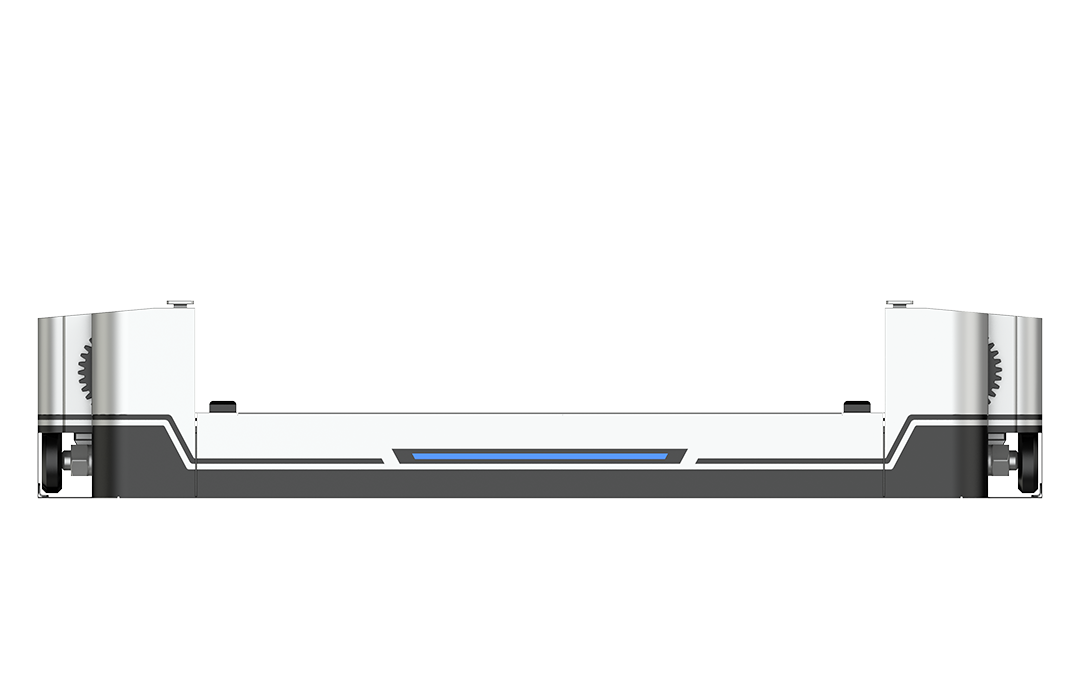
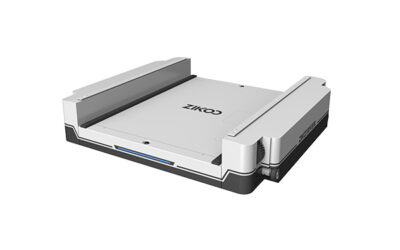
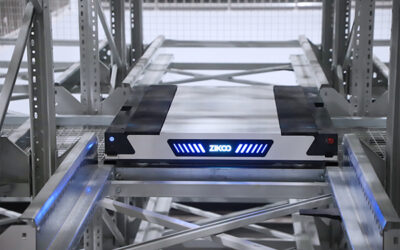
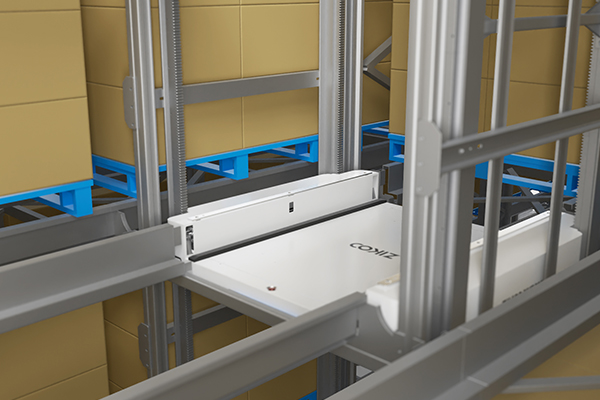
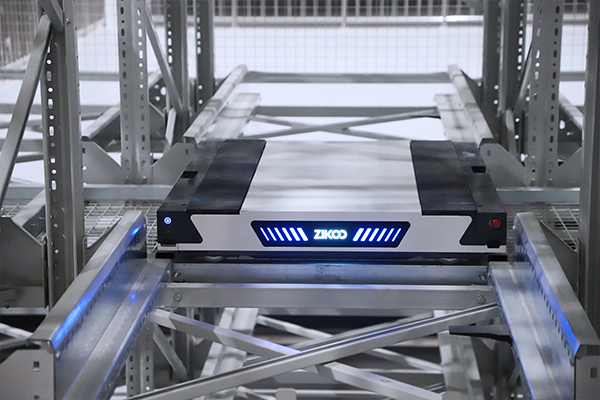
Semi-automatic pallet storage puts powered movement inside the lane and leaves everything else with people. A radio-controlled shuttle runs on rails fixed to the racking. A forklift sets the pallet on the lane face, the shuttle lifts it clear, carries it to the deepest free position and returns for the next task, and retrieval reverses the sequence. The operator still chooses the lane, still drives the pallet from the dock, and still decides what moves next.
A full ASRS removes those three functions. Rail-dependent storage and retrieval machines, or four-way shuttles working with vertical lifts, carry pallets between the rack and a conveyor or robot interface. A warehouse control system allocates every location and dispatches every task, and the storage zone runs closed to people during operation.
The distinction matters because each removed function adds fixed capital and a dependency. Removing transport means conveyors, lifts or robots. Removing the decision means a control layer that has to stay synchronized with the host system. Removing exception handling means sensors, redundancy, and a maintenance team able to diagnose a fault without walking the aisle. A semi-automatic layout stops after the first step, which is why its capital cost per pallet position is lower and why its residual labor does not disappear.
None of this makes semi-automatic storage a manual system. The lane is dense, the pallet is machine-carried, and pallet quality discipline still decides whether the system runs at all. What changes is the size of the bet.
Where a Full ASRS Earns Its Capital Cost
A crane or a shuttle fleet is capital committed per aisle and per machine. Cost per pallet movement falls as movements through that aisle rise, so the architecture earns its cost when demand is high and repeatable rather than merely large. Four conditions usually have to hold together:
- Most operating shifts run near the same pallet volume, so the machines are loaded rather than waiting
- Access latency matters, because a pallet has to be found and delivered inside a short window
- The building can take a high bay, or a new structure is being built anyway
- Forklift labor is scarce, costly, or the main safety exposure in the building
Height is the clearest of these. Rack served by a forklift is limited by the truck’s lift height and by the aisle the truck needs, while a crane-fed silo or a shuttle working with a vertical lift uses the full building envelope, so the same footprint holds more pallets. That gain is a one-time capacity purchase rather than an operating saving, and it should be compared against the cost of land or of a second building.
Sequence control is the second driver. When pallets must reach a production line or a dispatch door in a defined order, automated retrieval executes that sequence from the control system instead of reconstructing it with a forklift driver reading a pick list. The same capability tightens inventory accuracy, because every movement becomes a transaction rather than a note.
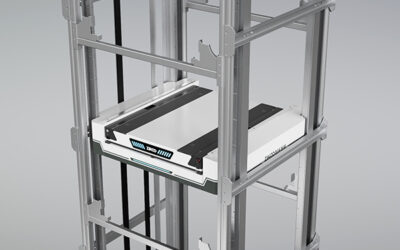
Inside a tall store, horizontal and vertical movement are separate problems solved by separate machines, which is why shuttle-and-lift architectures scale differently from a single crane per aisle. The vertical device is the shared resource, and its cycle time often sets the ceiling for the whole store.
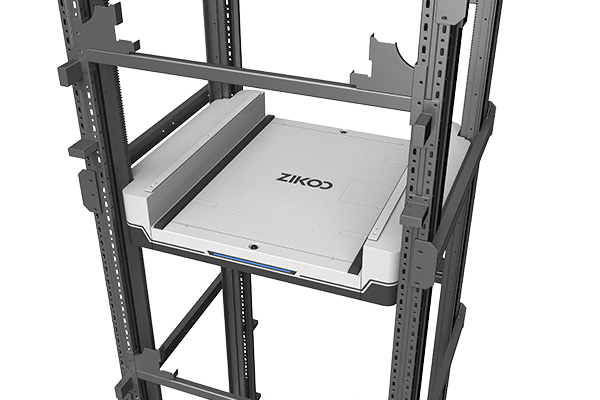
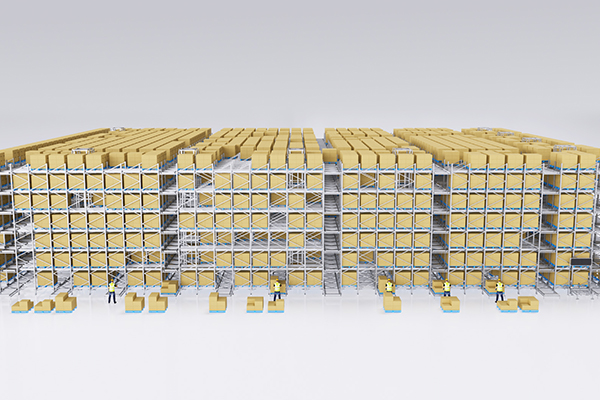
Building a three-dimensional store is an assembly problem rather than a machine purchase. <Six-Way Shuttle Drives Warehouse Upgrades: Building an Intelligent Automatic 3D Warehouse> covers the system-level view of combining rack, transport and software into one automated structure.
The third condition is how much failure the business can absorb. A closed storage zone concentrates throughput into fewer machines, so the availability required from each one is higher than the availability required from a forklift fleet doing the same work. That is a design requirement rather than a criticism. It has to be paid for with redundancy, spare parts, and maintenance access, and the cost belongs in the comparison from the first estimate.
Where Semi-Auto Storage Beats a Full ASRS
The case for stopping at semi-automatic is strongest where automated capacity would sit idle or where its failure would be felt immediately. The conditions tend to appear together.
Demand regularity comes first. A full ASRS is usually sized for peak, because capacity cannot be rented for a busy month, while a forklift fleet can be extended with a shift or a short-term hire. If the average month runs well below the peak, the automated system spends much of the year underloaded, and the capital that bought peak capacity earns nothing during the quiet weeks.
SKU velocity skew is the second condition. Automated retrieval saves time per movement, so it pays where pallets move often. In a warehouse where a small share of items drives most outbound volume and the rest sits for weeks, those slow positions occupy the best real estate in the building without generating a single automated cycle. Semi-automatic lanes store them densely and cheaply, and the fast movers can be served by a separate zone.
Building constraints are the third, and they are usually underestimated. Crane rails and lift masts transfer load into the floor and structure, so floor flatness, slab capacity, column grid and roof height all become engineering questions. Shuttle rails are carried by the racking itself, which relaxes the floor tolerance and lets an existing building take dense storage with far less civil work. Fire compartmentation and the cost of closing a zone to people also belong in this calculation.
Phasing is the fourth. Lanes can be added as volume grows, and each addition is a small capital release rather than a single commissioning event that has to be right the first time. Where the business case depends on a product mix that is still moving, deferring the fixed infrastructure is a rational position rather than a compromise.
Environment and serviceability decide many cold-store projects. Fewer powered devices in a freezer means fewer batteries, fewer chargers, and fewer low-temperature failures to manage, and a shuttle stranded in a lane can be recovered with a defined procedure while the rest of the store keeps working. A crane fault takes an aisle out of service and may need a technician on site.
Workforce capability closes the list. Semi-automatic storage builds on forklift and maintenance skills that most sites already have, while a full ASRS adds controls, network and software support to the maintenance scope. That capability can be hired or developed, but it is a real operating cost and a real lead time.
There is also a middle position that the two-way comparison often hides. Narrow-aisle stacker robots work inside conventional racking, need aisles of roughly 2.1 m, and lift to around 8 m, which removes the forklift from the aisle without closing the store or building a silo. Zikoo supplies both ends of that range, from the R-bot four-way shuttle with a 125 mm body and rated loads of 1.2 to 1.5 t for dense lane storage, to the U-bot omnidirectional stacker built for aisles from 2,100 mm. The practical point is not the hardware list. It is that the choice is a spectrum, and a site can move one step at a time.
What semi-automatic storage does not solve is equally clear. It leaves forklift traffic in the building, so safety exposure and labor cost stay on the books. It does not shorten access time, it does not eliminate picking errors caused by manual location handling, and it does not create the sequencing capability a production line may require. Where any of those is the dominant problem, the semi-automatic case weakens regardless of capital.
A Decision Table for Semi-Auto and Full ASRS Layouts
| Decision signal | Semi-automatic pallet storage fits when | Full ASRS fits when | Do not choose semi-auto when |
|---|---|---|---|
| Pallet movements | Volume varies by season or campaign and the average sits well below peak | Volume is high and repeatable across most shifts | Peak and average are both high and labor cannot flex |
| SKU velocity | A small share of items drives most movements and the rest sits for weeks | Most pallets turn within days and access must be fast | Every pallet needs same-shift access |
| Building envelope | Clear height, floor tolerance or column grid would need major works for a crane | The site can take a high bay, or a new structure is planned | The building cannot accept dense racking loads either |
| Capital and phasing | Budget is released in stages and lanes can be added without stopping the store | One commissioning event is acceptable | The business case depends on labor removal in year one |
| Environment | Freezer or harsh zone where fewer powered devices reduces upkeep | Temperature is stable and machines are serviceable from a controlled aisle | A stranded device would block outbound for a full shift |
| Workforce | Forklift and maintenance skills exist and can be trained | Labor is scarce, costly, or a safety exposure | Forklift traffic must leave the building entirely |
Use the table as a screening step, not a verdict. In practice the two architectures often share one building: dense semi-automatic lanes for slow and bulky inventory, an automated zone for the fast movers and for anything that must be sequenced. Hybrid layouts are common, and they usually cost less than automating everything while removing more labor than automating nothing.
What Drives Cost in Each Architecture
Cost comparisons between these two options fail most often on scope rather than on hardware. A semi-automatic budget typically covers racking steel, the shuttle count, a control handset, forklift capacity and operator training. A full ASRS budget has to cover structure, machines, lifts, conveyors, fencing and access control, the control layer and its host interface, building works, commissioning, spare parts and a service contract. Comparing one total against the other without matching those boundaries produces a gap that says nothing about efficiency.
A second error is comparing cost per pallet position only. Positions are cheap in a dense lane and expensive in an automated silo, but the silo also removes labor per movement. The useful comparison runs both units, per position and per movement, and states the annual volume assumed in each.
Break-even arithmetic is simple enough to run before any vendor is called. Count pallet movements per year, estimate the forklift and operator minutes each movement consumes today, and multiply by the loaded hourly cost of that labor to get the annual labor pool the automation competes for. Compare that with annualized capital (installed cost divided by the amortization period your finance team accepts) plus service, spares, energy and software support. The difference is the annual net before any throughput or accuracy benefit. Run it twice, once at average volume and once at peak, because a full ASRS is usually priced at peak while a semi-automatic layout can be staffed to the average.
Cost reduction claims only compare when both sides use the same scope and the same annual volume. <Six-Way Shuttle: The Ultimate Warehousing Solution for Cost Reduction and Efficiency> covers how shuttle-based automation is positioned against cost and efficiency targets.
Utilization then decides whether the arithmetic holds. A machine that runs through most of two shifts spreads its capital over many movements. The same machine loaded for half a shift spreads it over few, and no service contract will fix that.
Failure Modes That Change the Choice
Downtime exposure is where close decisions are actually settled. A semi-automatic layout degrades by lane. A failed shuttle blocks one lane, and the operation continues from the remaining lanes and from the forklift fleet. A full ASRS degrades by aisle, and if inbound or outbound passes through that aisle, the whole flow stops. Compare the two on time to recover multiplied by the cost of an hour of stopped shipping, not on failure frequency alone.
Pallet quality affects both, but with different consequences. Pallets with broken deck boards, protruding fasteners, loose wrap or crushed corners can jam a shuttle inside a lane, where recovery means extracting the device rather than lifting the load clear. Cranes and shuttles both lift from below, so a pallet that sags or overhangs its bearers is a mechanical problem, not a data problem. A pallet inspection and repair standard is part of the system, whichever architecture is chosen.
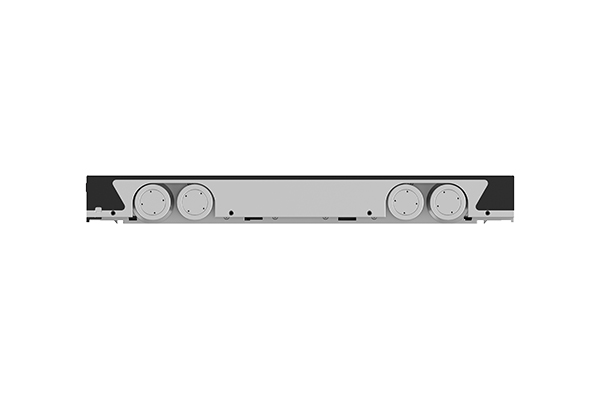
Energy and battery strategy belong here too. Cold stores need low-temperature battery packs and charging arrangements that work below freezing, and the number of powered devices directly sets how much of that maintenance burden the site carries. Fewer devices is an operating advantage that rarely appears in a capital comparison.
Software dependency is the last failure mode worth naming. A full ASRS stops when the control layer loses its host interface, even if every machine is healthy, and recovery depends on how well the degraded mode was specified and tested. A semi-automatic layout keeps working with a location log and a handset. That difference matters in businesses where the order cut-off cannot move.
How to Qualify Either Option Before You Commit
Assemble the data pack before requesting prices, because a supplier who receives it will quote a comparable scope. The list is short and most of it already exists somewhere in the business:
- Pallet dimensions, load, overhang and current damage rate
- Movements per day, peak hour and the seasonal ratio between them
- SKU count and the split between fast, medium and slow movers
- Required access latency and any sequencing requirement
- Clear height, floor tolerance, column grid and fire compartment layout
- Temperature zone and any washdown or humidity condition
- Labor cost, shift pattern, and the maintenance skills available on site
- Downtime tolerance expressed as the cost of a stopped shipping hour
- Growth forecast over the period the capital will be amortized
Then treat the evidence you collect according to what it can actually support.
| Record | What it can legitimately support | What it cannot prove |
|---|---|---|
| Reference site visited during operating hours | That the layout, pallet quality rules and staffing model work in practice | That the throughput you watched transfers to your order profile |
| Vendor simulation using your data | A predicted throughput under the assumptions entered | Availability after a fault, or performance at your pallet damage rate |
| Quote line items | The scope boundary and what is excluded | Total cost of ownership over the amortization period |
| Warranty and service terms | Response obligations and spare parts commitments | That a repair will finish inside your production window |
Integration deserves its own acceptance test rather than a paragraph in the contract. Confirm which system owns the location master, how a task is confirmed, what happens when the host goes down, and what the manual fallback looks like in practice. A control layer that cannot be tested before go-live becomes a production risk after it.
The software boundary matters more than the machine count once a store runs without people inside it. <PTP Intelligent Warehouse Software Empowers Enterprises for Smart Upgrades> covers the warehouse software layer used to run automated storage and picking operations.
A final check is worth more than another quotation. Take the three or four pallet types that cause most of your exceptions today and walk them through both proposed layouts on paper. If the semi-automatic design needs a recovery procedure you cannot staff, or the automated design needs a pallet standard your suppliers cannot meet, that is the constraint to solve before signing, not after commissioning.
Send Your Pallet Profile and Throughput Data
The fastest way to settle which architecture fits is to test your own numbers against both. Send the pallet dimensions and current damage rate, daily and peak-hour movements, SKU count with the fast and slow split, clear height and floor tolerance, temperature zone, shift pattern and loaded labor rate, plus the cost of a stopped shipping hour. With that set, a layout can be reviewed against dense semi-automatic lanes, a shuttle and lift configuration, or a narrow-aisle robot solution without guessing at scope.
Zikoo Smart Technology Co., Ltd designs pallet-to-person systems across that range and can review the same data against more than one architecture before a layout is priced. Reach the team at info@zikoo-int.com or (+86)-19941778955.
FAQ
Can a semi-automatic shuttle layout be upgraded to a full ASRS later?
Sometimes the racking is reused, more often it is not. Reuse depends on whether the original design left suitable bay depths and beam levels, but three items usually force a rebuild: floor and foundation capacity for crane rails or lift masts, clear height and roof structure, and the fire compartment around a closed storage zone. The practical approach is to fix the building envelope and the pallet specification first, then buy the level of automation the current volume justifies. Deciding the envelope early keeps the later upgrade open without paying for it now.
How many pallet movements justify a full ASRS?
There is no universal number, because the threshold depends on loaded labor cost, shift pattern, building cost and required access latency. The test is utilization: a machine that runs through most of two shifts spreads its capital across many movements, while the same machine loaded for half a shift does not. Run the annual labor pool against annualized capital at both average and peak volume. If the automated case only clears at peak, a semi-automatic layout with flexible forklift capacity is usually the lower-risk commitment.
Is semi-automatic storage still worth it where labor is cheap?
It can be, but the case has to rest on something other than wages. Dense lane storage reduces floor space per pallet, which matters where land or rent is the binding constraint. It also cuts pallet damage from repeated forklift handling and keeps fewer people working in freezer conditions. Where labor is genuinely cheap and stable, the labor-saving argument weakens, and the decision should be justified on space, safety and product integrity instead.
What pallet condition problems stop a shuttle or a crane?
Broken deck boards, protruding fasteners, loose or torn wrap, overhanging loads, crushed corners and ice build-up in freezer lanes are the usual causes. Both shuttle and crane devices lift the pallet from below, so a pallet that sags between its bearers or carries anything protruding can catch on rails, stops or the device itself. A written pallet inspection standard, a repair route for damaged units, and a rejection rule at the dock prevent most of these events.
Does semi-automatic pallet storage need WMS integration?
It needs less integration, not none. A semi-automatic lane still requires a location master, task confirmation and periodic inventory reconciliation, but the operator supplies the decision that a full ASRS takes from the control layer. Many sites run it from a warehouse module with a location log and a handheld confirmation step, then extend integration when the automated zone arrives. The important question is which system owns the location record, because that boundary decides how reconciliation is handled.
If you’re interested, check out these related articles:
Software-Driven Hardware: Six-Way Shuttle Maximizes Warehouse Efficiency
Revolutionizing Cold Chain Logistics: Zikoo Robotics Six-Way Shuttle Powers High-Density, High-Efficiency Warehousing