The automated storage vs pallet racking decision often centers on space savings, but the real differentiators are throughput, flexibility, and total cost per pallet moved. High-density automated shuttle systems excel in warehouses above 5,000 pallet positions where multi-SKU handling and high throughput are required, delivering a lower cost per pallet moved than standard racking. For low-volume, low-SKU operations, however, standard pallet racking remains the simpler and more capital-efficient choice.
High-Density Automated Storage and Standard Pallet Racking Defined
In pallet storage, two distinct approaches dominate warehouse design. Standard pallet racking, typically selective rack, arranges frames and beams into single-deep lanes with aisles wide enough for forklift access. Every pallet is immediately reachable, and rack structure is entirely passive. Drive-in and push-back racking increase density but still rely on forklifts and reduced selectivity.
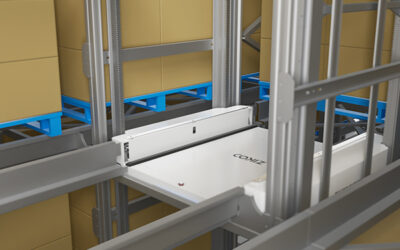
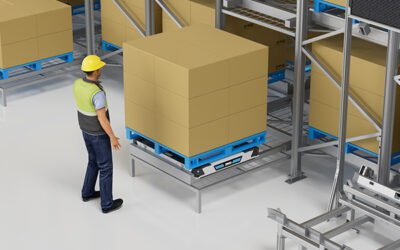
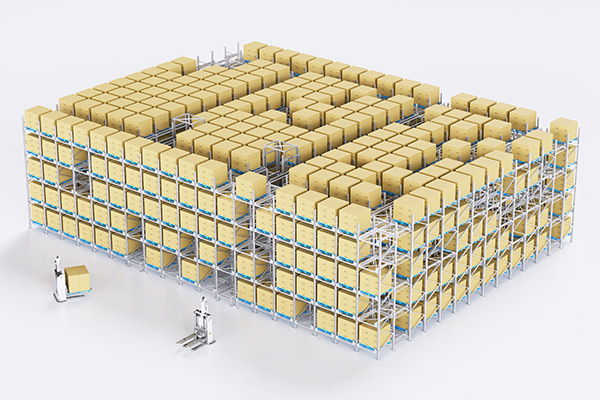
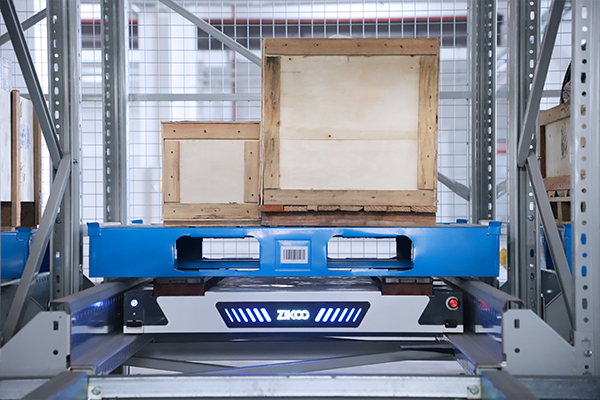
High-density automated storage takes a fundamentally different approach. A pallet shuttle system such as a four-way shuttle ASRS runs on rails within deep storage lanes, carrying pallets from the front face to any position in the lane. A vertical lift, typically an elevator-type mechanism, brings pallets to a pickup and deposit station at floor level. These systems integrate with warehouse execution software to automate putaway and retrieval sequences. Space savings come from eliminating the wide aisles that forklifts need; lanes can be several pallets deep and separated by only the width of the shuttle body.
Storage Density and Space Savings Compared
Density differences are stark. Standard selective racking typically uses roughly 40–45% of the building footprint for actual storage once aisle space is accounted for. A four-way shuttle system can push that figure above 80% because aisles between lanes are reduced to the minimum clearance required for the shuttle, and vertical space is used more efficiently with higher racking. This translates directly into more pallet positions inside the same building envelope. For facilities with high land or construction costs, doubling the number of storage slots within an existing footprint can reshape the entire business case.
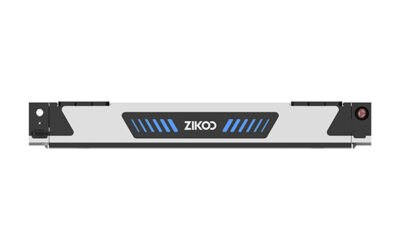
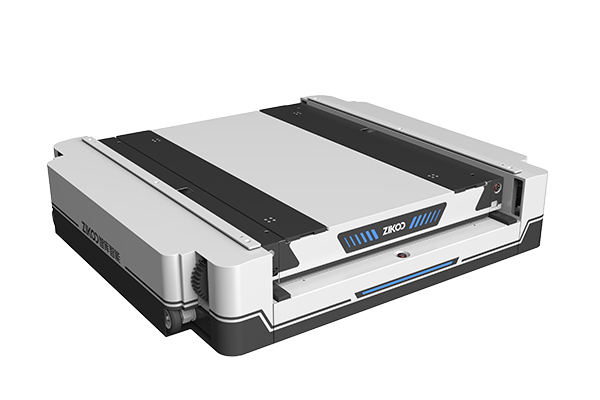
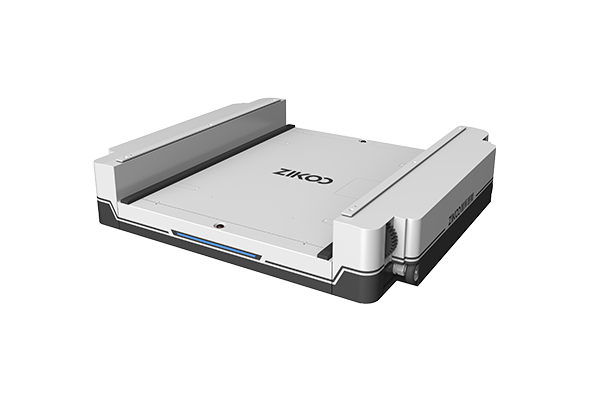
The R-bot four-way shuttle, with a body thickness of 125 mm and a rated load up to 1.5 tons, is designed precisely for this density. Its compact dimensions allow racking lanes to be tightly spaced, while the shuttle’s four-way movement eliminates the need for intermediate cross-aisles. Still, density alone is not the full picture. The cost per pallet stored drops with automated high-density systems, but the cost per pallet moved depends on how the system handles throughput and picks.
Throughput and Flexibility: The Overlooked Differentiators
Standard racking has a genuine advantage in single-pallet retrieval time. A forklift operator can pull any pallet in roughly 30–60 seconds. In a deep-lane shuttle system, the worst-case retrieval requires the shuttle to move pallets behind the target pallet to a buffer position, then extract the target and relocate the buffered pallets. Without careful slotting and WMS logic, deep-lane retrieval can take several minutes per pallet.
In practice, the gap narrows with intelligent software. We have seen properly tuned shuttle systems sustain 80–100 dual-cycle moves per hour per lane in manufacturing and 3PL environments. Batch picking algorithms group retrievals so that multiple pallets from the same lane are extracted together, amortizing the deep-lane repositioning time across an entire wave. The key factor is not the peak retrieval speed of one pallet but the sustained throughput the system can deliver across a shift.
Handling Multi-SKU Warehouses
When an operation stores thousands of SKUs with varying turnover patterns, a shuttle-based ASRS can dynamically slot pallets based on velocity. High-turn items sit close to the lane face; slow movers fill the deep positions. Standard racking, by contrast, tends to suffer from pick-path inefficiencies as SKUs proliferate. The ability to reconfigure slot assignments through software without physically moving rack gives the automated system a flexibility that static racking cannot match.
| Storage Type | Effective Aisle Ratio | Typical Retrieval Time (Single Pallet) | Sustained Throughput (Pallets/Hour per Lane) |
|---|---|---|---|
| Standard Selective Rack | 55–60% aisle space | 30–60 seconds (forklift) | 15–25 |
| Drive-In Rack | 25–35% aisle space | 90–120 seconds (forklift) | 10–15 |
| Four-Way Shuttle ASRS | 10–20% aisle space | 60–180 seconds (deep retrieval); 30 seconds (face) | 40–80 (with batch picking) |
Total Cost of Ownership from Capital to Payback
Standard pallet racking carries the lowest upfront cost per pallet position. However, total cost per pallet moved includes labor, MHE maintenance, energy, and facility costs over the system’s life. A shuttle system eliminates the need for forklifts inside the storage zone and reduces headcount required for putaway and retrieval. In a warehouse processing 500 pallets per shift with 12 operators, moving to automated handling can free 6–8 operators for other tasks. Over five to seven years, the cumulative labor savings alone often surpass the initial hardware investment difference, especially in regions with rising labor costs.
Space savings convert directly to lower cost per pallet stored, but the real leverage point is throughput-per-square-meter. When a facility can double its storage slots without expanding the building, the capital avoided from new construction can offset a significant portion of the automation cost. This is why we frequently see shuttle systems pay back within three to five years in greenfield projects that would otherwise require a much larger footprint.
Warehouse Scenarios Suited to Each System
High-density automated storage delivers its strongest returns in cold storage, high-value inventory, high-SKU distribution, and manufacturing raw-material buffers where consistent throughput is critical. For example, the cold-chain custom solution using the R-bot with -25°C-rated batteries and coated electronics dramatically reduces the time that personnel spend inside freezers, directly improving safety and productivity. The U-bot omnidirectional stacker robot can serve aisles as narrow as 2,100 mm, making it a candidate even in existing warehouses where standard racking aisles are too tight for reach trucks.
Standard pallet racking remains the better fit for operations with fewer than 3,000 pallet positions, low turnover, or unpredictable workload patterns. A seasonal produce distributor that needs heavy forklift access for quality checks and split loads will likely find standard racking more flexible. The capital savings are real, and the operational simplicity avoids the need for specialized maintenance staff.
Cold Storage and Special Environments
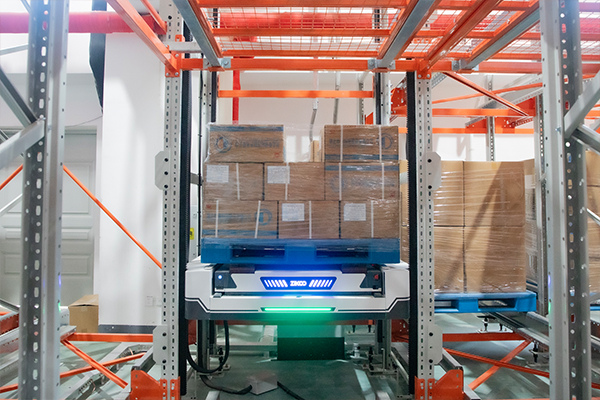
Cold storage amplifies the labor advantage of shuttle systems. In -25°C environments, worker shifts are limited and error rates climb with fatigue. A fully automated lane with dedicated low-temperature batteries and remote monitoring keeps operations running 24/7 without exposing staff to extreme cold. When Zikoo’s U-bot is configured with lithium iron phosphate batteries and laser SLAM navigation, it can operate continuously for 6–8 hours in narrow, conditioned aisles, moving pallets without any human presence in the freezer. For cold-chain operators, that shift alone changes the labor-cost equation.
Integrating Automation Without Rebuilding Your Warehouse
One persistent concern is whether an existing warehouse can accommodate automated shuttle storage. Clear ceiling height of at least 10 meters strongly favors the business case, but systems like the U-bot with 8-meter lift height can work with lower clearances. Floor flatness tolerances matter: shuttles require rail mounting surfaces within a few millimeters across the lane length, which may necessitate localized floor grinding or rail-leveling plates. Rack structure must be engineered for the dynamic loads of moving shuttles and pallets, not just static storage.
Software integration is often the longer lead item. The shuttle, elevator, and conveyor systems must synchronize through a WCS that communicates with the host WMS. A platform that natively integrates WMS, WES, WCS, and fleet control simplifies this, but the effort to map warehouse zones, define putaway rules, and tune wave-picking logic should not be underestimated. We find that a thorough simulation of expected order profiles before hardware commissioning prevents the bulk of throughput shortfalls.
A Storage Assessment Based on Your Warehouse Data
The choice between high-density automated storage and standard pallet racking turns on throughput requirements, SKU dynamics, facility characteristics, and labor economics, not just space savings. A system that looks cost-effective on a cubic-foot basis can underperform if retrieval logic is not tuned to your order profile, or if floor tolerances drive up installation cost. Getting the analysis right before committing to a layout avoids expensive mid-project changes.
Zikoo Smart Technology offers a no-obligation system assessment that evaluates your throughput targets and facility constraints against the appropriate automation configuration. Send your warehouse dimensions and daily pallet movement data to [email protected] or call (+86)-19941778955 to discuss which storage solution fits your operation.
Common Questions About Pallet Storage Choices
How much more expensive is high-density automated storage than standard racking up front?
Initial hardware and software costs for a shuttle-based ASRS typically run two to five times the cost per pallet position of standard selective racking, depending on lane depth, crane or elevator count, and software complexity. The difference narrows when you factor in the avoided building expansion, reduced forklift fleet, and labor savings over the system’s life. In facilities where each additional pallet position would require a building addition, automation often becomes the lower total investment.
Can an existing pallet racking structure be converted to automated shuttle storage?
Conversion is rarely practical. Shuttle rails require precise mounting tolerances and a rack structure engineered for moving loads. Existing selective racking is almost always undersized for the dynamic forces and lacks the integrated rail supports. A purpose-built rack structure must be installed, typically within the same building shell. However, if the building has sufficient clear height and floor load capacity, a new shuttle system can often be added without major structural modifications, and existing racking can be phased out.
What payback period should be expected for a shuttle-based ASRS?
In our project experience, well-matched shuttle systems achieve payback in three to five years when replacing manual racking in high-throughput facilities. The calculation depends heavily on labor rates, facility costs, and the number of shifts. Operations running three shifts in cold storage can see payback in under three years due to the combination of labor reduction and personnel safety improvements.
Do low-turnover warehouses ever benefit from automated storage?
Rarely. If pallets turn less than four times per year per slot, the throughput advantage of automation does not offset its capital cost. Standard pallet racking with occasional forklift moves remains more economical in these cases. Automated dense storage becomes valuable when turnover per slot exceeds eight to ten times per year, and especially when multiple SKUs must be accessible throughout the day. For operations exploring automation in lower-turnover environments, a phased approach starting with a manual rack core and an automated high-velocity zone often makes more financial sense. If your operation involves mixed turnover profiles, reach out to discuss a segmented automation design that balances capital cost with the throughput you need.
If you’re interested, check out these related articles:
Revolutionizing Cold Chain Logistics: Zikoo Robotics Six-Way Shuttle Powers High-Density, High-Efficiency Warehousing
Six-Way Shuttle Unlocks the Era of True 3D Intelligent Warehousing
Six-Way Shuttle System Leads the Shift from Machines to Robots in Dense Storage Automation