Four-way shuttle sorting efficiency is not determined by shuttle speed alone. It is produced by dispatch sequencing, lift coordination, and pallet presentation working as one system. In our project work at Zikoo, the largest cycle-time reductions usually come from changing the order in which pallets leave storage, not from buying a faster robot. When a warehouse treats sorting as a storage problem, it leaves throughput on the table. When it treats sorting as a sequencing problem, the same shuttle fleet can improve picks per hour without adding headcount.
What Limits Warehouse Sorting Speed in Pallet Operations?
Sorting performance in a pallet warehouse is usually limited by three conditions: travel distance, lift waiting time, and pallet presentation. A forklift may need several minutes to cross the floor, retrieve a pallet, and return it to a pick face. A shuttle shortens that travel but can still waste motion if the dispatch rules are poor. The warehouse team sees the symptom as pallets backing up behind each workstation. The mechanism is simpler: the storage system is releasing work faster than the workstation can receive it, or the workstation is waiting because the next pallet is still in transit.
Where Does the Delay Usually Accumulate?
The delay rarely builds in straight-line travel. It builds at transfer points, lift queues, and workstation receiving slots. We measure each node by the time from task assignment to pallet release. In many existing warehouses, the receiving slot is the hidden bottleneck because operators unload pallets with different wrap quality and pallet condition. Sorting speed does not improve if the shuttle arrives faster and then waits for the workstation to clear. Before adding equipment, we map the movement path for the ten highest-velocity SKUs. That exercise usually shows the bottleneck sitting in transition points rather than in raw robot speed.
How Do Four-Way Shuttles Change Pallet Sorting Workflow?
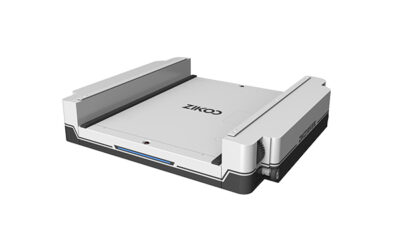
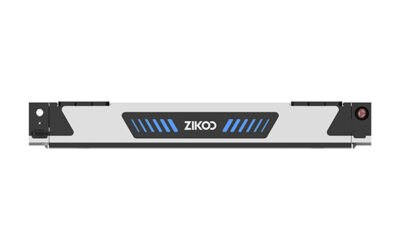
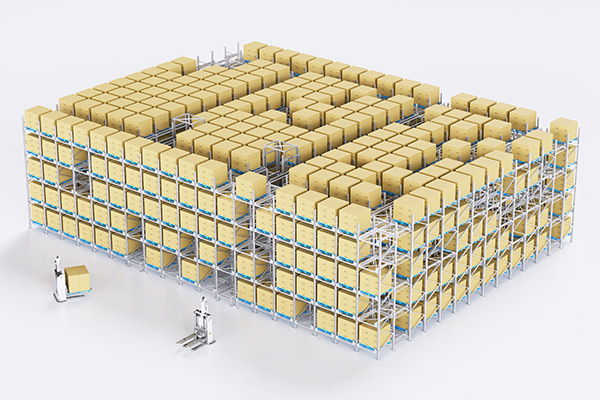
A four-way shuttle changes sorting workflow by removing fixed aisle and forklift constraints. The R-bot runs on rails inside the rack, moves in four directions within a layer, and carries a pallet without a long floor travel path. Because the shuttle body is 125 mm high, more rack levels fit into the same building height. Because the system stores pallets in depth, SKUs can be grouped by order frequency rather than by aisle convenience. That grouping has a direct effect on sorting: the WCS can stage high-velocity SKUs closer to the lift and keep slow-moving SKUs in dense rear lanes. The result is a shorter average pallet travel distance for the items that actually drive daily order volume.
Which Pallet Specifications Change the Shuttle Choice?
The shuttle choice is governed by pallet dimensions, load, and the bottom board pattern. The R-bot standard type fits 1200 by 800 to 1000 mm pallets. The American type fits 1016 by 1219 mm pallets. The heavy-duty large pallet type carries up to 2000 kg and uses a 150 mm body height. Mixing pallet types without adjusting the rail gauge or model selection creates a slower system because the shuttle loses time correcting position at the pick face. At Zikoo, we match the model to the pallet before we lay out the rack.
| Model | Rated load | Body height | Travel speed loaded | Battery runtime |
|---|---|---|---|---|
| Standard R1200B | 1200 kg | 125 mm | 1.2 m/s | 8 hours |
| American R1200A | 1200 kg | 125 mm | 1.2 m/s | 8 hours |
| Japanese R1500J | 1500 kg | 125 mm | 1.2 m/s | 8 hours |
| Heavy-duty R1500B | 1500 kg | 125 mm | 1.2 m/s | 8 hours |
| Heavy-duty large pallet R2000B | 2000 kg | 150 mm | 1.0 m/s | 7 hours |
Why Does Dispatch Sequencing Matter More Than Robot Speed?
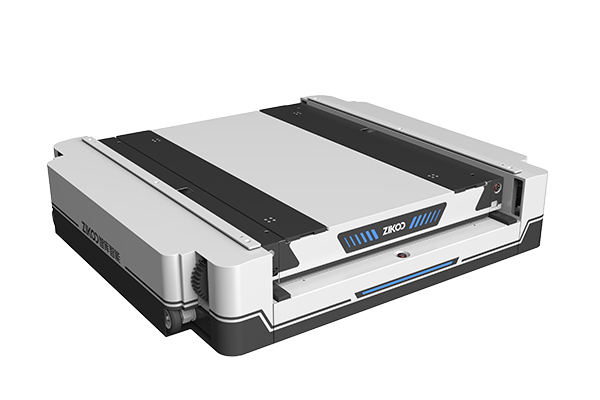
Robot speed is easy to measure. Dispatch sequencing is where sorting efficiency is actually won or lost. A shuttle can travel at 1.6 m/s empty and 1.2 m/s loaded, but if it returns empty across a long rack face for every second task, the speed gain disappears. We evaluate dispatchers by deadhead distance, lane-change count, and order cut-off compliance rather than by top speed. In simulation before deployment, we sometimes find that closing a non-critical lane or changing the task release window improves pick rate more than a theoretical speed increase. The machine appears busy, but the sequence is bad.
What Does Good Task Interleaving Look Like?
Good interleaving means a shuttle completes a putaway on its return path instead of traveling empty. If a pallet is scheduled for a rear deep lane and another pallet needs to go from the lift to a front lane, the dispatcher combines them. The shuttle never simply returns home. In poorly tuned systems, we see the same shuttle run empty after every retrieval, which is wasted cycle time. The correction is not more speed. The correction is reducing empty travel.
Software-defined dispatch turns the same shuttle fleet into a faster sorting system, <Software-Driven Hardware: [Six-Way Shuttle](https://www.zikooint.com/solution/r-bot-h-bot-six-way-shuttle-dense-storage-system) Maximizes Warehouse Efficiency> covers why the control layer, rather than the shuttle motor, is the point where throughput changes.
If your operation mixes full pallet outbound with case picking, the shuttle count and lift duty cycle need to be checked against your actual order profile. Send your SKU mix and pick wave data to [email protected] before you commit to a rack layout.
What Happens When Shuttles and High-Speed Lifts Work as One System?
Many sorting delays occur when a pallet is moved horizontally but then waits for vertical transfer. The R-bot and H-bot pairing changes that by turning a single-layer shuttle field into a six-way system. The H-bot vertical bidirectional shuttle moves pallets between levels and holds a positioning accuracy of ±1 mm. The R-bot carries the pallet inside the layer. We design lift call windows so that a shuttle arrives at the lift face just as the lift becomes available, rather than queuing multiple shuttles at the transfer point. In dense pallet operations, this coordination removes the manual staging step and lets the WCS sequence retrieval by outbound wave. The effect is strongest when order volume is high, SKUs are deep, and pallets from multiple levels must combine at the picking station.
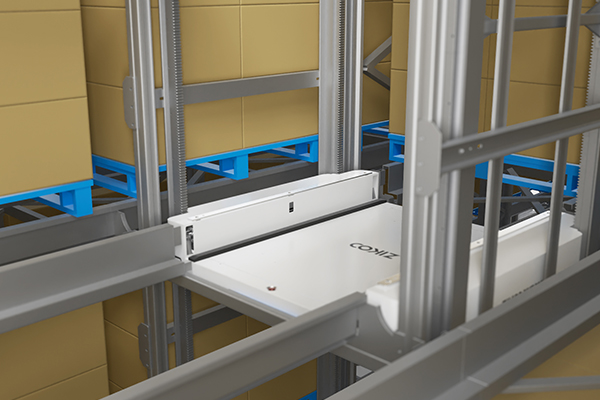
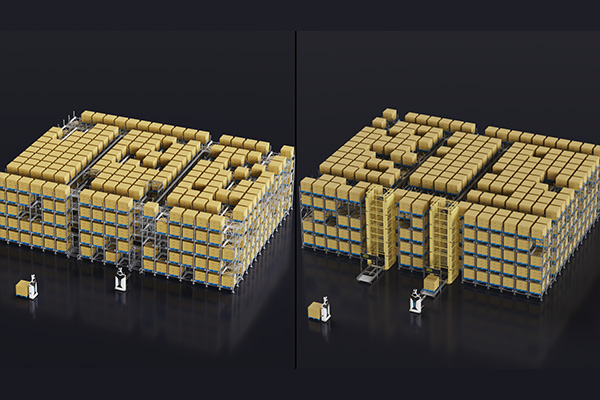
For pallet systems that need vertical movement, adding a vertical shuttle changes the material flow from a set of separate aisles into one sorting network, <Six-Way Shuttle: Pioneering the Future of Smart Warehousing> covers how vertical transfer points are placed to prevent lift queues and keep the shuttle fleet productive.
What Should You Ask a Four-Way Shuttle Supplier Before Signing?
Most sorting efficiency problems are not caused by the shuttle alone. They come from a mismatch between the rack layout, the dispatch rules, and the outbound order profile. A supplier can ship a capable robot and still leave you with a system that misses cut-off times if those three elements are not modeled together.
At Zikoo, we ask for pallet dimensions, order cut-off times, SKU count, and inbound patterns before we quote a sorting system. That data lets us test whether the bottleneck will sit in shuttle travel, lift cycles, or workstation sequencing. Without that step, you are buying hardware into an unverified operating model.
Send your pallet dimensions, SKU profile, order cut-off times, and target picks per hour to [email protected] or call (+86)-19941778955. Include a sample dispatch day and we will confirm shuttle count, lift sizing, and takt time.
What Do Warehouse Teams Ask About Four-Way Shuttle Sorting Systems?
Will a four-way shuttle system still work if my pallet sizes vary?
It depends on how mixed the pallet types really are. Standard, American, and Japanese pallets each correspond to a specific shuttle model and rail gauge, so the system can handle mixed sizes only when the supplier configures for them. The bigger constraint is usually pallet condition. A shuttle cannot correct a damaged pallet or an uneven bottom board. Check that your pallets sit flat and that the load does not overhang the shuttle deck. If your facility mixes multiple pallet formats, confirm which model and rail spacing apply before you sign.
Is sorting speed limited by the shuttle battery or the shuttle count?
Speed is rarely the true bottleneck. The R-bot moves at 1.6 m/s empty and 1.2 m/s loaded, and the battery delivers roughly eight hours of continuous operation. Most sites do not hit a hard speed limit. What matters more is how many non-value-added return trips the dispatcher schedules. We have watched sorting output improve after reducing empty shuttle travel without changing the robot hardware at all. If pick rates are below plan, ask for a task interleaving review before adding another shuttle.
Does adding a vertical shuttle always improve sorting efficiency?
The better question is whether your sorting wave pulls pallets from multiple levels. A vertical shuttle improves performance when orders require pallets from several rack levels in the same wave. If most sorting work stays on one level, the lift only adds cycle time and cost. The deciding variable is wave depth. When orders pull from many levels at once, the H-bot removes the manual handoff and keeps the four-way shuttle working. When order lines are single-level, the lift can wait. Ask your integrator to simulate one week of actual order data before adding vertical capacity.
What happens if one shuttle stops during a sorting wave?
In installations we have supported, a stopped shuttle does not shut down the warehouse. The WCS isolates the unit from the active task pool and reassigns its work, while the pallet stays locked in its lane until recovery. That is why we design systems with redundant shuttle paths and replaceable battery packs. The real question for a buyer is how the control software handles failure recovery, not what the shuttle uptime figure says. Share your failure recovery requirements at [email protected] and we will confirm how the WCS isolates equipment events.
If you’re interested, check out these related articles:
Six-Way Shuttle System Leads the Shift from Machines to Robots in Dense Storage Automation
Stacker Crane vs Four-Way Shuttle: Which Fits Your ASRS Warehouse Best