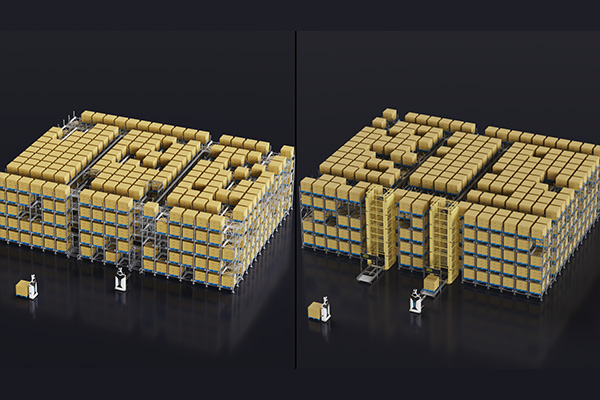
When a warehouse adds 40% more pallet positions without expanding the building footprint, the efficiency gain is not theoretical. We see this repeatedly in projects where manual or forklift-based storage is replaced by a four-way shuttle system. The mechanics are straightforward: shrinking aisles from 3 meters to just over 2 meters, stacking pallets 12 deep in a single lane, and having shuttles handle the horizontal travel while an elevator manages vertical lifts. The result is a compact, high-density block that cuts travel time, labor hours, and energy consumption. But not every shuttle system produces the same result. The hardware and control software decisions made during the design phase determine whether efficiency stays on a spreadsheet or shows up on the warehouse floor.
How Dense Storage Increases Throughput Per Square Meter
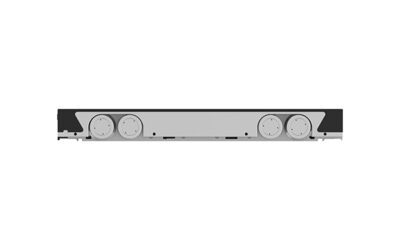
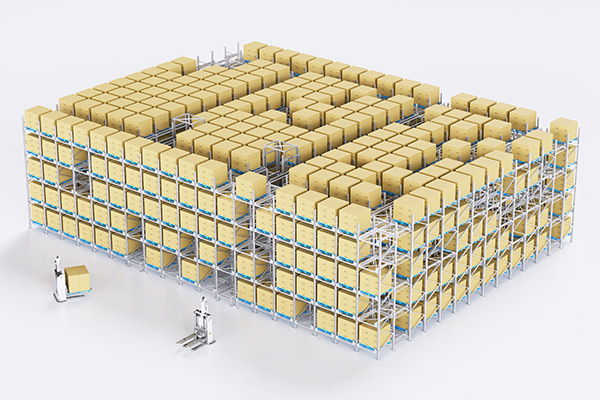
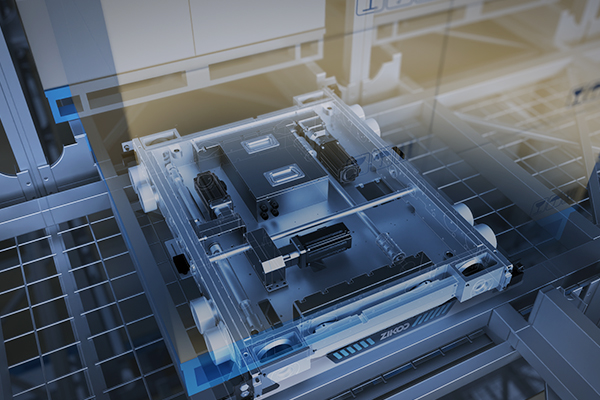
A standard pallet racking aisle with reach trucks eats about 3 meters of floor width. A four-way shuttle system reduces that to roughly 2.1 meters, and the shuttle body itself is only 125 mm thick, so the floor-level clearance adds almost nothing. That means for the same building length, you can fit 30–40% more storage lanes. The deeper the lane, the higher the density. We commonly design lanes with 8–12 pallets in depth; at 10 deep, a single aisle can hold 20 pallets across two lanes per level. With the R-bot at 1.2 m/s loaded speed, retrieval time from the deepest position averages under 25 seconds, including elevator transfer. The key efficiency metric here is not just pallets per square meter but throughput per square meter. A dense storage block must deliver pallets fast enough to keep outbound docks fed. That requires coordination between shuttle fleets and the elevator, which is where the system architecture matters more than the shuttle speed alone.
Why System Architecture Matters More Than Shuttle Speed
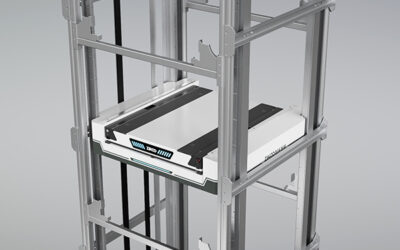
A shuttle that moves at 1.6 m/s empty is not faster than one at 1.2 m/s if it spends 30% of its time waiting for a free elevator. In a six-way shuttle setup, the R-bot and H-bot elevator work as a single transport layer. The H-bot positions at ±1 mm accuracy and transfers a loaded pallet in roughly 12 seconds. The shuttle fleet is sized so that the elevator never idles. We calculate the cycle time for each lane and floor, then assign a shuttle count that keeps the elevator at 85–90% utilization without queuing. Below 80% and you have overspent on shuttles; above 95% and you risk bottlenecking the entire block during peak hours. This is not a rule of thumb, it is a simulation output we verify during commissioning.
System-level design determines whether a dense storage block can sustain throughput targets across multiple floors. <Six-Way Shuttle: The Dual-Engine Solution for High-Density and High-Throughput> covers how pairing shuttle fleets with vertical lifts in a coordinated control layer prevents elevator queuing from eroding the gains of dense storage.
How Warehouse Automation Reduces Picking Errors and Labor Hours
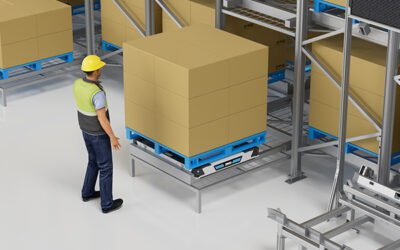
Labor cost and error rate are tightly coupled. A picker walking 12 km per shift in a manual warehouse makes location errors when fatigued. An automated system removes the walking and the decision of where to go next. The WMS directs the shuttle to retrieve a specific pallet and deliver it to a picking station. The operator stays at the station, and the system presents the correct pallet every time. We have measured picking error rates below 0.05% in live operations using this pallet-to-person model. Labor hours drop because the same operator can process 30–40 pallet movements per hour instead of 15–20. In a 2-shift operation, the labor reduction alone offsets roughly 60% of the annualized automation cost within the first 18 months.
The Real Efficiency Gains: Space, Energy, and Throughput Data
We track three metrics on every project: space utilization, energy per pallet move, and sustained throughput. A 8,000-pallet four-way shuttle installation with 6 levels typically achieves 85–90% space utilization by reducing aisle count and using deep-lane storage. Energy consumption averages 0.12 kWh per pallet move, including shuttle and elevator power. That is roughly one-fourth of a counterbalance forklift’s consumption for the same move, and the shuttle runs on rechargeable lithium batteries that last 8 hours on a full charge. Sustained throughput per shuttle lane is 25–30 pallets per hour, and a single elevator serves 4–6 levels without degrading that rate. The table below shows how these metrics compare across system types.
| System Type | Space Utilization | Energy per Pallet Move (kWh) | Sustained Throughput (pallets/hr) | Typical Payback Period |
|---|---|---|---|---|
| Forklift & wide aisle racking | 45–55% | 0.45–0.60 | 15–20 | — |
| VNA (very narrow aisle) truck | 60–70% | 0.35–0.45 | 18–22 | 3–5 years |
| Four-way shuttle (6 levels) | 85–90% | 0.10–0.15 | 25–30 per lane | 2–3 years |
| Six-way shuttle (multi-floor) | 88–92% | 0.10–0.14 | 30–35 per lane | 2–3 years |
Where Automation Efficiency Falters Without Software Integration
Efficiency breaks at the interface between hardware and WMS. A shuttle can retrieve a pallet in 22 seconds, but if the WMS releases the next order 45 seconds later, throughput drops by half. The PTP software stack (WMS/WES/WCS/RCS) synchronizes order release, shuttle dispatch, and elevator scheduling so that the gap between retrievals stays below 5 seconds. In one manufacturing project, activating the WES’s dynamic task-batching algorithm increased outbound throughput by 19% without adding any hardware. The integration layer is where efficiency projects actually succeed or fail, because no amount of shuttle speed compensates for idle time caused by software latency.
Automation ROI calculations often overlook the cost of software latency because the focus stays on hardware specifications. <PTP Intelligent Warehouse Software Empowers Enterprises for Smart Upgrades> covers how task-batching algorithms and real-time dispatch reduce inter-pallet gaps to under 5 seconds, turning dense storage into sustained throughput.
If your warehouse handles 2,000 or more pallets and outbound volume exceeds 150 pallets per day, a four-way shuttle system typically delivers efficiency gains that justify the investment within 24 months. Share your pallet dimensions, rack height, and daily throughput targets with us at [email protected], and we will provide a space utilization and throughput simulation specific to your facility. We can usually confirm whether a shuttle configuration will meet your targets before you allocate budget for a site survey.
What Buyers Ask Before Committing to a Pallet Shuttle System
Shuttle speed is not what caps throughput.
A shuttle moving at 1.6 m/s empty is fast, but throughput tops out when the elevator cannot clear pallets quickly enough. We design around elevator cycle time first, then calculate how many shuttles are needed to saturate it. Most projects need 3–5 shuttles per elevator, not the maximum the spec sheet lists. Adding more shuttles beyond that number adds cost with zero throughput gain.
A four-way shuttle system does not require a new building.
We have retrofitted existing warehouses with clear heights as low as 6 meters and floor loads of 2 tons per square meter. The R-bot body is 125 mm thick, and the rail system bolts to the existing slab without deep foundations. The constraints are usually column spacing and dock door placement, not the building age.
Payback periods we see are 2–3 years, not 5.
When throughput exceeds 25 pallets per hour and the operation runs two shifts, labor savings and space consolidation typically recover the investment in under 3 years. The variability comes from energy costs, local labor rates, and whether the building was already at capacity. A warehouse that needs more storage but cannot expand physically often sees a first-year space cost avoidance that alone justifies the project.
Cold storage environments do not degrade shuttle performance.
The R-bot operates continuously at -25°C with a dedicated low-temperature lithium battery rated for 6–8 hours. The PCBA coating protects against condensation during defrost cycles. We have systems running in frozen food warehouses that maintain full throughput without heated charging rooms.
Software maturity determines long-term efficiency, not just launch success.
A WES that only schedules tasks in FIFO order will leave shuttles idle during batch changes. We deploy a WES that uses real-time shuttle position data and order priority to resequence tasks every 500 milliseconds. That dynamic scheduling sustains throughput as SKU profiles and order patterns shift over time. When evaluating a supplier, ask to see a screenshot of the WES task queue during a peak hour, not just a brochure.
If your team is comparing proposals and wants to verify quoted throughput numbers against independently collected project data, reach us at [email protected] or call (+86)-19941778955. We can share benchmark figures from comparable installations so you can validate supplier claims with real operational data.
If you’re interested, check out these related articles:
Standardization Empowers Global Delivery: Zikoo Robotics Six-Way Shuttle Expands Overseas
Six-Way Shuttle Unlocks the Era of True 3D Intelligent Warehousing
Multi-Scenario Smart Adaptation: Zikoo’s Six-Way Shuttle Powers the Digital Transformation of Warehousing