A warehouse handling 9,000 mixed SKUs can lose more throughput at the workstation than in the storage aisle. Mixed SKU robotics works only when the pallet access pattern, SKU velocity spread, and order line count drive the system design. I have seen distribution centers buy fast shuttle systems and still miss daily cutoffs because the real bottleneck was downstream picking and sequencing. This article explains what to size first before selecting robots, workstations, or software.
Mixed SKU Profiling Sets the Design Baseline
Before any robot count, I ask for the order line and SKU velocity distribution. A facility with 20,000 SKUs where 1,200 SKUs produce 80% of lines behaves differently from one where 8,000 SKUs produce that same 80%. The first case can buffer fast movers at pick faces and use automation for slow movers. The second forces nearly every storage position into the picking pool. That changes how many robot retrievals must be staged per hour and how much conveyor downstream must absorb.
How Should SKU Velocity Be Classified?
I classify SKUs by line frequency, not by inventory value. A slow moving electrical component may sit in deep reserve but still appear in one order out of every twenty. A fast moving beverage case may have low value but create constant replenishment traffic. For mixed SKU robotics, line frequency and the peak two-hour window matter more than annual movement.
| Order profile | What it puts under pressure | Design consequence |
|---|---|---|
| 70 to 80% of lines from 15 to 20% of SKUs | Pick face replenishment and shuttle retrieval frequency | Fast pick face plus dense slow mover storage |
| Lines spread across 60% or more of SKUs | Retrieval mix, workstation sequencing, robot idle time | More shuttles or fewer static positions |
| High line count per order with mixed case sizes | Workstation handling and pack consolidation | Multi-function workstations, not just faster robots |
Pallet Handling Unit Shapes the Storage Business Case
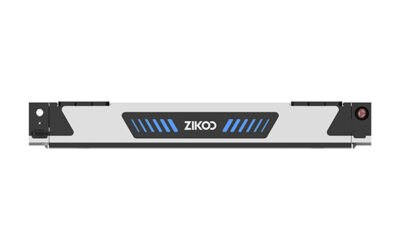
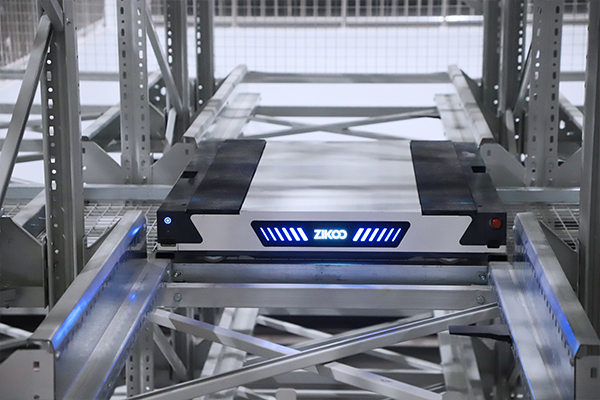
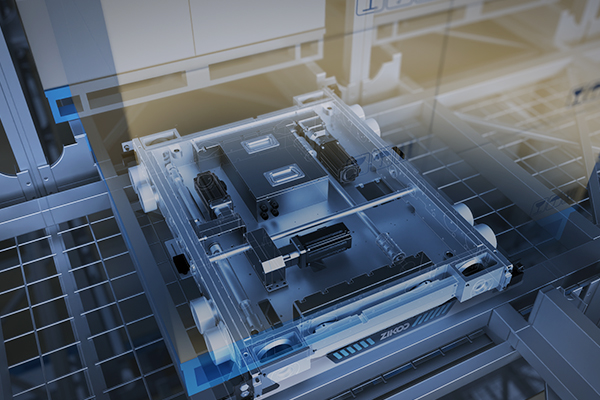
A mixed SKU building often cannot standardize on one pallet footprint. The R-bot Four-way Shuttle models handle 1200 x 800 to 1000 mm pallets, 1016 x 1219 mm pallets, 1100 x 1100 mm pallets, and 1400 mm pallets. The 125 mm body height preserves vertical spacing because the robot lives inside the rack lane rather than consuming an aisle. Load rating reaches 1.5 tons on most models and 2 tons on the large pallet variant. For mixed SKU operations, I look at pallet weight before pallet count. A 1,200 kg pallet of fast moving beverage cases does not stress the shuttle. The same weight in dense metal parts changes acceleration and battery consumption across an 8 hour shift.
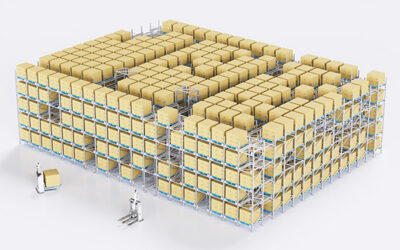
On the storage side, dense rack design still sets how many retrieval cycles the system can sustain over a shift. <Six-Way Shuttle Powers Dense Storage: Breaking Space Limitations> covers how vertical shuttle integration changes the space and throughput trade-off in high-density mixed SKU racks.
Workstation Design Determines the Mixed SKU Picking Ceiling
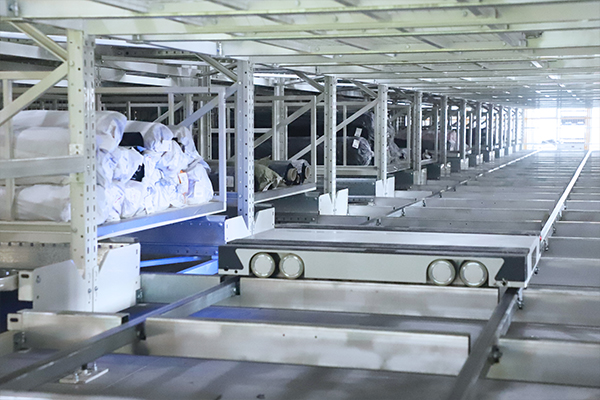
If a facility runs 40,000 order lines per shift, robot speed is rarely the binding constraint. The U-bot + AMR Narrow Aisle Picking System illustrates why. Its system performance target lists picking efficiency at 300 pieces per hour or more and inbound/outbound flow at 80 pallets per hour. The workstations must handle full pallet outbound, case picking, and split-case picking without forcing all three through one decision point. Mixed SKU orders create the worst peaks because a single order can contain a full pallet, ten cases, and two eaches. That variety moves into the station at different arrival times. A station that cannot decouple those flows turns robot throughput into waiting time.
Why Do Mixed SKU Peaks Move Into the Workstation?
The U-bot operates in aisles as narrow as 2100 mm and can store up to 10,000 SKUs when paired with AMR picking. The constraint then shifts to the order consolidation sequence. If five robots deliver picks faster than the pack station can clear them, the buffer fills and every upstream robot slows down. That is why I size workstations by peak line arrival, not by average daily throughput.
If your order profile mixes pallet, case, and each lines in the same wave, it is worth confirming the workstation design and the U-bot + AMR flow split before finalizing robot numbers. Send your daily line count and SKU count to info@zikoo-int.com and we can check whether the throughput target is realistic for your building.
Software Sequencing Ties Multiple Robot Types Together
R-bot, H-bot, U-bot, and AMR fleets do not share work by chance. The PTP Smart Warehouse Software layers WMS, WES, WCS, and RCS functions so orders are sequenced across storage, vertical transfer, and picking. For mixed SKU orders, the hardest software job is not directing a single robot. It is deciding the release order of 300 to 500 mixed tasks across multiple floors and keeping the workstation fed without building a buffer that is too large. I want the control layer to show me the exception queue, the replenishment queue, and the picking queue separately. If those queues are hidden, the site team cannot keep the system stable after launch.
The H-bot Vertical Bidirectional Shuttle moves pallets between levels at 1 m/s empty and 0.5 m/s loaded, with positioning accuracy of ±1 mm. In a mixed SKU building, that vertical handoff becomes the point where a missed task or a late release shows up first. Software has to release pallets early enough for the H-bot to feed the floor without building a queue that blocks other moves.
Those control decisions determine whether the system stays stable when order mix changes between a morning retail wave and an afternoon wholesale wave. <PTP [Intelligent Warehousing](https://www.zikooint.com/asrs-automated-storage-and-retrieval-system-solutions) Platform: Building a Flexible and Smart Logistics Ecosystem> covers how the platform structure links warehouse execution and robot control for mixed order profiles.
Supplier Checks That Separate Workable Systems From Pilot Projects
Five checks separate a system that survives go-live from one that only works in a sales deck. First, ask for simulation output with your actual line count and SKU velocity, not a generic throughput figure. Second, verify reference sites with the same SKU spread, order line count, and case mix. Third, ask what happens to the queue when one H-bot stops. Fourth, confirm spare part holdings and remote support response time. Fifth, check pallet dimensions across all robot models before slab and rack design are fixed.
| Check | What it reveals |
|---|---|
| Simulation run with your actual line count and SKU velocity | Whether quoted throughput applies to your profile |
| Reference visit with similar SKU spread, order lines, and case mix | Whether the supplier has operated in your condition |
| Single H-bot or shuttle failure drill | How much of the system stays available |
| Spare part and remote support commitment | Recovery time after launch |
| Rack and pallet tolerance check | Whether the robot fits the day-one and day-two SKU set |
Too many mixed SKU projects are sized on pallet moves and executive presentations, then corrected at go-live with overtime. If you are at the point of comparing quotations, ask us to run the order profile through our simulation or design review. Email your SKU count, daily order lines, and the fastest moving 200 SKUs to info@zikoo-int.com, or call (+86)-19941778955 to schedule a technical review before rack dimensions are fixed.
Common Questions About Mixed SKU Robotics
Does more SKU variety always require more robots?
Not automatically. Robot count depends first on how many retrieval lines must be completed during the peak wave and how many of those lines can be batched by SKU. A 20,000 SKU site with strong concentration may need fewer robots than an 8,000 SKU site where lines are evenly spread. I size the robot fleet from the peak two-hour window, because that is where mixed SKU work creates the largest queue. If the peak cannot be met without adding a second shift, the robot count is probably too low or the pick face design is wrong.
What should go into the order profile before asking for a quote?
Many buyers stop at total SKU count and pallet capacity. That leaves out the line distribution, case dimensions, pallet weight, order line count per wave, and the split between full pallet, case, and each picking. We request the SKU master list and a week of order history before quoting. The design changes when 30% of orders contain only one line versus when 70% contain five lines or more, because that changes how much consolidation must happen between retrieval and dispatch. Without that profile, any quote is a budget placeholder.
Can existing racking be reused for mixed SKU automation?
It depends on aisle width, rack integrity, and pallet type. Existing racks sometimes convert well when the aisle can accept a U-bot and when uprights are within the tolerance needed for shuttle rails. Misaligned or damaged racking makes accuracy suffer because a shuttle cannot correct enough for a structure that has moved over the years. I have seen retrofit projects where the rack had to be reinforced after the robots were installed, and that delay was far more costly than checking at the design review stage. A structural check before quoting is always cheaper than a structural repair during commissioning.
How long should a mixed SKU robotics project take from design to stable operation?
In the projects I have worked on, the design and simulation phase runs four to eight weeks. Installation and commissioning then depend on rack work, floor condition, and software integration. A greenfield site may take five to seven months. A retrofit can take longer when the building remains in operation. We plan for a shakedown period of two to four weeks after system handover, during which order mix and exception handling are tuned with the site team. Share your target go-live date and we can confirm what is achievable for your facility.
If you’re interested, check out these related articles:
Revolutionizing Cold Chain Logistics: Zikoo Robotics Six-Way Shuttle Powers High-Density, High-Efficiency Warehousing
Six-Way Shuttle Drives Warehouse Upgrades: Building an Intelligent Automatic 3D Warehouse