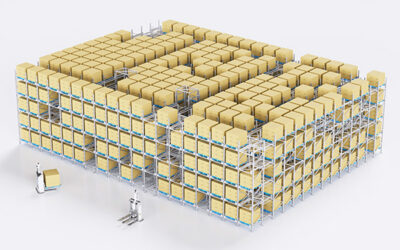
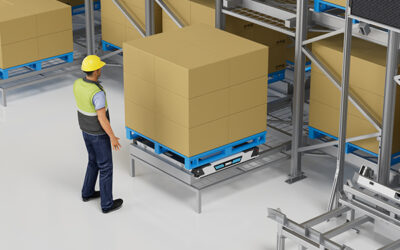
Four-way shuttle systems are increasingly judged by software as much as by shuttle speed. The component that determines whether a multi-shuttle system stays fluid under peak workload is the warehouse control system (WCS). This article explains four-way shuttle + WCS mission orchestration: what the WCS layer does, how it coordinates shuttles, vertical lifts and workstations, and which acceptance criteria matter before go-live.
Where WCS Sits in the Control Stack
In pallet-to-person automation, four software layers usually share execution responsibility. WMS handles inventory, locations and order management. WES sequences work into waves and balances labor. WCS manages real-time equipment missions at system level. RCS runs individual robot motion and lower-level control.
| Layer | Primary role | Typical decision horizon |
|---|---|---|
| WMS | Inventory, location master, order processing | Hours to days |
| WES | Wave building, labor balancing, order release | Minutes |
| WCS | Mission dispatch, traffic control, exception handling | Sub-second to seconds |
| RCS | Robot trajectory, motor control, safety interlocks | Milliseconds |
Industry guidance consistently places WCS as the equipment-facing execution layer below WMS and WES, translating work into robot-level directives [1]. For a four-way shuttle system, RCS may reside on individual robot controllers or a central controller, while WCS remains system-level. Some suppliers merge WCS and RCS; even then, mission orchestration and machine control should remain conceptually separate for upgradeability and fault isolation.
What Mission Orchestration Actually Does
Mission orchestration is not a single algorithm. It is a set of coordinated behaviors.
- Mission decomposition: one WMS outbound order becomes several missions—Shuttle A retrieves from a lane, Lift B accepts at level 3, Shuttle C delivers to a picking station.
- Dispatch and path planning: WCS selects a shuttle based on position, battery state, maintenance status and traffic, not simply nearest-robot logic.
- Traffic and deadlock control: intersections, lane reservations and lift windows are scheduled so the fleet does not block itself.
- Exception recovery: failed shuttles or lifts trigger re-dispatch, mission re-planning and order reassignment.
- Safety state handling: light curtains, E-stop zones, safe speed limits and interlocking functions operate through controls designed with functional-safety practices [2].
Mission orchestration is where dense storage shifts from fixed machine routing to software-defined material flow. <Six-Way Shuttle System Leads the Shift from Machines to Robots in Dense Storage Automation> covers how shuttle control architectures move from machine-style logic to robot-style mission execution.
Hardware That Must Execute the Software Decision
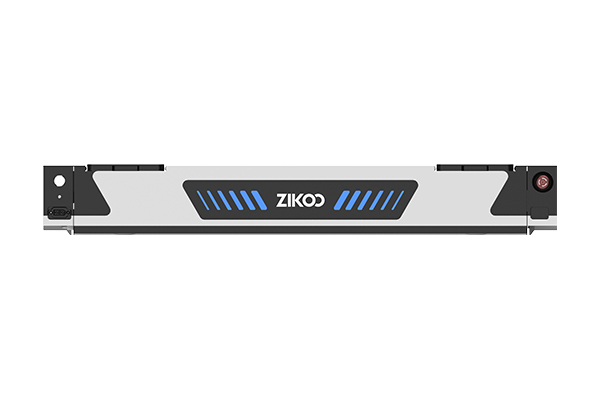
A WCS can only execute what the physical fleet supports. Zikoo’s R-bot four-way shuttle uses a 125 mm body height, moves in four directions within a racking plane, and is built in load classes up to 2,000 kg for specialized pallet sizes. Standard loaded travel speed of 1.2 m/s and empty speed of 1.6 m/s give the mission planner a predictable cycle-time basis; 7–8 hour battery endurance creates shift-level energy planning. In cold storage, the low-temperature lithium battery configuration supports operation at -25°C.
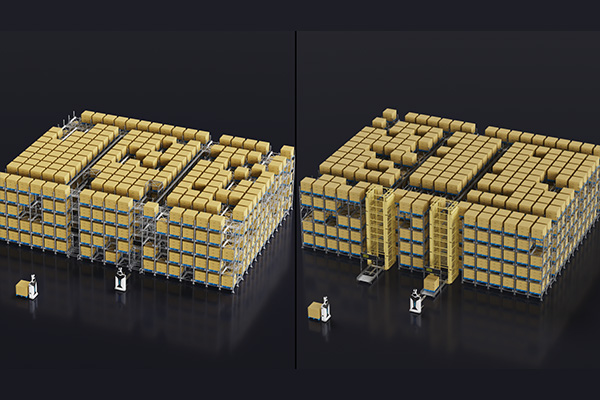
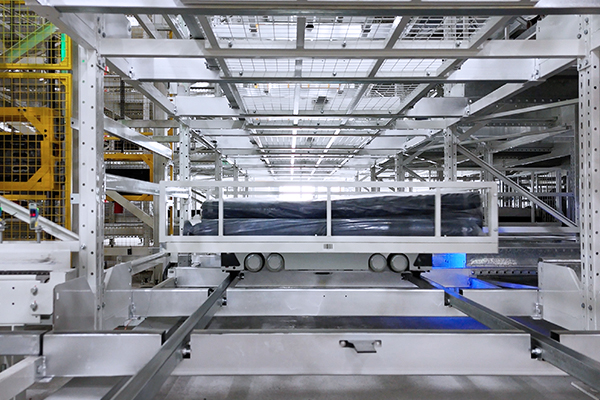
The H-bot vertical bidirectional shuttle acts as the vertical transfer hub. It provides ±1 mm positioning accuracy, a rated load of 1,800 kg on standard models, and an operating range from -25°C to 45°C. It connects levels, racks and workstations into a six-way shuttle network. For narrow-aisle pallet-to-person tasks, the U-bot omnidirectional stacking robot operates in aisles as narrow as 2,100 mm with lifting up to 8 m.
Where Mission Orchestration Gets Difficult
In practice, three conditions separate robust WCS design from fragile performance. First, traffic around vertical lifts is often the true bottleneck: if WCS does not balance shuttle missions against H-bot capacity, the lift becomes a serial constraint. Second, tight rack geometry matters. Rack deformation, clearance, and pallet condition influence whether a mission executes on the first attempt. Static racking standards define the tolerances used during mechanical commissioning [3]. Third, inbound, replenishment and outbound workflows are not independent; they compete for the same shuttles.
Mission orchestration also extends into high-SKU mixed operations. When U-bot covers upper storage and AMRs handle lower split-case picking, the control layer must maintain different equipment speeds, task priorities and exception boundaries without turning the picking station into a stalling point.
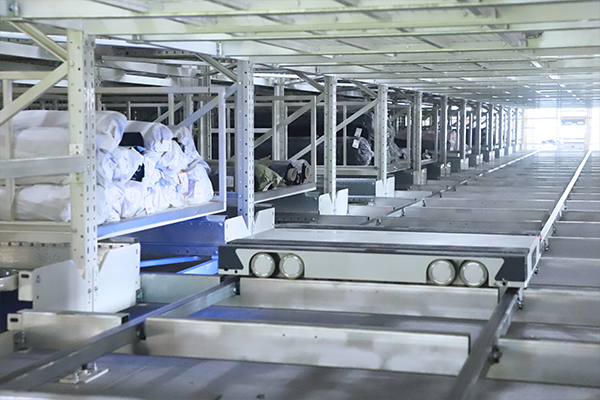
Mission orchestration also depends on how the storage platform handles vertical transfer and multi-level pallet flow. <PTP Intelligent Warehousing Platform: Building a Flexible and Smart Logistics Ecosystem> covers how WMS/WES/WCS/RCS modules coordinate putaway, storage and picking in pallet-to-person systems.
Acceptance Criteria for Mission Orchestration
Buyers should not accept shuttle speed on paper. Define mission-level tests instead:
- Stress test with the worst-hour order profile.
- P50 and P95 mission completion times.
- Deadlock recovery without manual intervention.
- Lift failure simulation and automatic order reassignment.
- Battery-swap and maintenance windows, with their effect on throughput.
- WMS/ERP interface latency and retry behavior.
Compare systems under identical order mix, not identical robot counts, because equipment count alone does not predict mission-level throughput. Industry performance reporting increasingly focuses on system-level metrics [4].
Once mission orchestration moves to live operation, system acceptance should include dynamic tests, not only cycle-time calculations. <Stacker Crane vs Four-Way Shuttle: Which Fits Your ASRS Warehouse Best> covers the architectural comparison that informs throughput and flexibility expectations.
Before asking for bids, send the supplier your actual daily order curve, pallet dimensions, SKU velocity and building constraints. Zikoo’s engineering team uses these inputs to model shuttle counts, lift positions and charging strategy. For a mission-level configuration review, contact info@zikoo-int.com or call (+86)-19941778955.
Get a Mission-Level Feasibility Review
The strongest WCS design starts with your data, not a generic shuttle count. Zikoo Smart Technology Co., Ltd. builds pallet-to-person robotics and PTP Smart Warehouse Software with WMS, WES, WCS and RCS capabilities. The team supports power, cold chain, new energy, manufacturing, pharmaceuticals and third-party logistics projects.
Prepare your SKU list, hourly throughput peaks, pallet sizes and weights, building drawings, and current WMS/ERP interface. Send them to info@zikoo-int.com or call (+86)-19941778955 to discuss an engineered simulation before investment.
FAQ
What is the difference between WCS and RCS?
WCS manages missions at system level: which shuttle should do what, in what sequence, and how traffic should be controlled. RCS executes individual vehicle movement, including navigation, acceleration, positioning and sensor handling. In some architectures RCS is onboard and WCS is central. In others they are combined, but separating mission logic from vehicle control usually simplifies fault handling and future upgrades.
Does every four-way shuttle system need WCS?
Any multi-shuttle operation beyond simple semi-automatic lane movement needs a control layer that dispatches, coordinates and recovers missions. A small single-lane system may be controlled by remote or PLC logic, but high-throughput, multi-shuttle storage requires WCS-level orchestration for traffic management, lift coordination, order sequencing and exception reallocation.
How does WCS prevent shuttle deadlock?
Through lane and intersection reservations, directional rules, and lift window scheduling. WCS builds a reservation graph and refuses new missions that would close the last available path. If equipment fails mid-mission, the system re-plans and can redirect work to alternative shuttles or lifts when the fleet has available redundancy.
Can existing WMS integrate with four-way shuttle WCS?
Usually yes, through API, web service, database views, flat files or message queues. The integration must define order messages, task confirmations, inventory moves and error states. If WMS cannot release small executable tasks, a WES layer is often added. Ask the supplier for an integration data catalog and a go-live simulation before sign-off.
What data should I prepare before WCS design review?
Prepare the SKU master including dimensions, weights and velocity; hourly inbound and outbound peaks; order lines per wave; pallet types; building drawings with column grid and clear height; operational calendar and shift model; WMS/ERP version and interface constraints; and availability expectations. These inputs allow the supplier to simulate mission throughput rather than quote an isolated theoretical cycle time.
References
[1] MHI, “Warehouse Control Systems: The Bridge Between WMS and Automation,” MHI, Charlotte, NC, USA, 2023.
[2] ISO 13849-1:2023, Safety of machinery — Safety-related parts of control systems — Part 1: General principles for design, ISO, Geneva, Switzerland, 2023.
[3] EN 15620, Steel static storage systems — Tolerances, deformations and clearances, CEN, Brussels, Belgium, 2021.
[4] MHI, 2024 Annual Industry Report: The Collaborative Supply Chain, MHI, Charlotte, NC, USA, 2024.
If you’re interested, check out these related articles:
Software-Driven Hardware: Six-Way Shuttle Maximizes Warehouse Efficiency
Smart Cold Chain Era: Six-Way Shuttle System Redefines Storage Efficiency with Maximum Density
Standardization Empowers Global Delivery: Zikoo Robotics Six-Way Shuttle Expands Overseas