Where Does Inventory Pressure Actually Come From?
Inventory pressure is not simply too many pallets. It is the gap between how fast stock arrives and how fast the warehouse can make it available for the next order. A manual warehouse usually absorbs that gap with floor storage, double handling, and fixed racking. When inbound volume rises, pallets land in staging areas because there is no confirmed putaway slot. The WMS may know a pallet exists, but the physical system cannot move it quickly enough to a location the picking process can use. Three pressure points appear repeatedly: dock congestion, location fragmentation, and decision lag. Dock congestion means receiving queues block outbound trailers and force operators to reshuffle pallets. Location fragmentation means the same SKU sits in several zones, so order assembly must search for available stock. Decision lag means inventory counts are correct on screen, but task release waits for a supervisor or a paper-based priority. Pallet automation reduces pressure when it removes one of those three bottlenecks, not merely when it adds storage positions.
Pallet pressure often looks like a storage problem but behaves like a queueing problem. <Six-Way Shuttle: The Smart Warehousing Tool for Cost Reduction and Efficiency> covers how shuttle systems reduce the cost and time penalty of queue-driven warehouse movement.
How Does Pallet Automation Reduce Inventory Pressure?
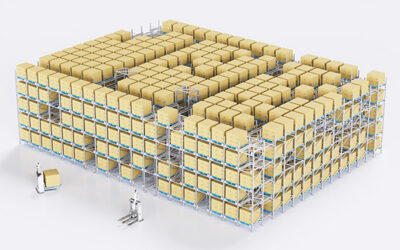
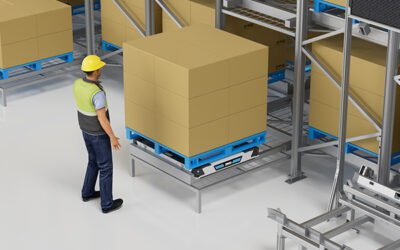
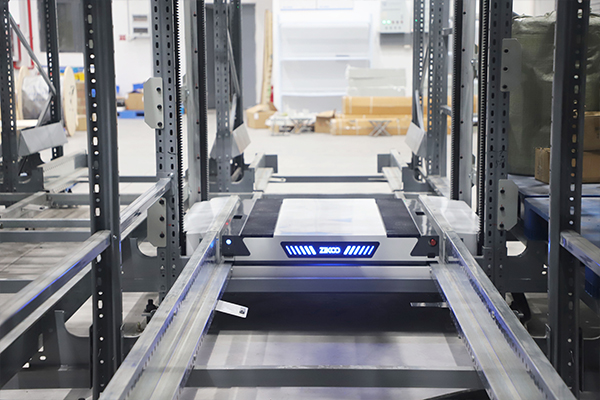
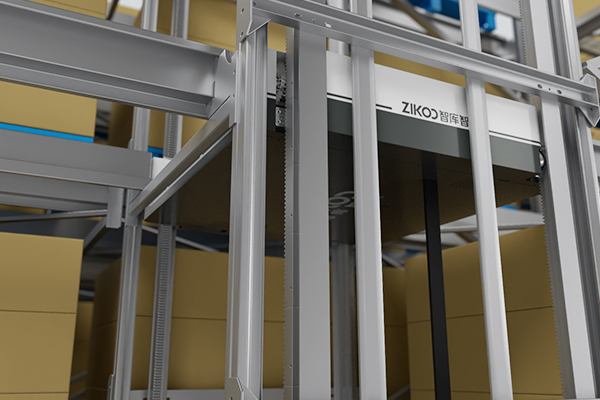
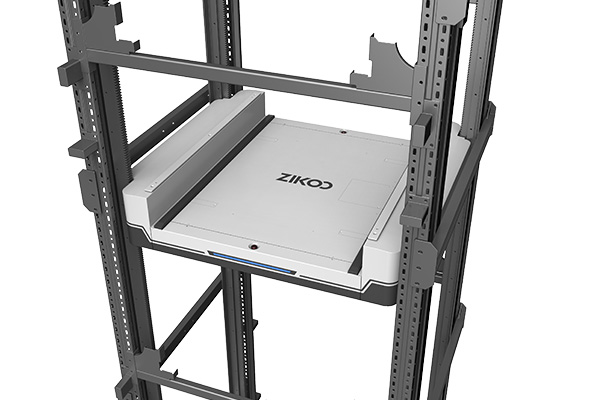
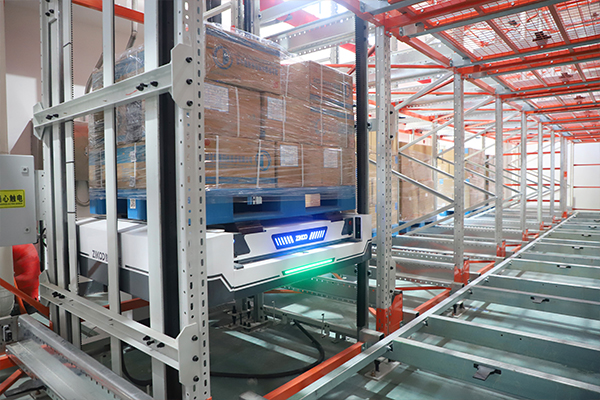
Pallet automation attacks inventory pressure by making storage movement predictable and task release automatic. The first change is that a pallet no longer waits for a forklift operator. An R-bot four-way shuttle moves under the pallet in a 125 mm body and carries up to 1.5 t through dense storage lanes. Putaway becomes a robot task with a confirmed destination, not a manual search for an open bay. The second change is that the WMS and WCS convert inventory status into a task sequence from receiving to inspection to location assignment to order release. When those steps run without supervisor intervention, inventory that would sit in staging for a shift becomes available in minutes.
Why does throughput affect inventory pressure more than storage capacity?
Throughput changes the pressure point. A warehouse can have empty racking and still feel inventory pressure if pallets leave the dock slowly. In projects we have assessed, storage utilization was not the first constraint; the outbound queue was. Adding pallet positions would have raised inventory holding cost without reducing the queue. A pallet automation system works because it processes the same number of pallet moves in a shorter time window. The R-bot travels at 1.2 m/s loaded in most models, and the H-bot vertical shuttle moves pallets between levels with positioning accuracy within 1 mm. Those specifications matter less as top speed and more as repeatable throughput, which is what keeps a dock queue from becoming a replenishment failure.
How does automated pallet storage shorten the putaway to order release cycle?
When putaway is a manual decision, every pallet consumes operator attention. Automated storage shortens the cycle by assigning a location from the WMS and dispatching the robot in the same event. A six-way shuttle configuration that combines R-bot horizontal movement with an H-bot vertical lift removes the transfer point where pallets wait between horizontal and vertical movement. That wait is what turns a live pallet into safety stock. Once the handoff is robot to robot, the inventory remains in motion, and the system does not need a large buffer to protect order assembly. This is the difference between a pallet automation project that speeds up movement and one that actually reduces the stock sitting in reserve.
Why Does Pallet Automation Need WMS and WCS to Reduce Inventory Pressure?
Robots move pallets, but software decides what should move next. In an automated pallet warehouse, the WMS sets inventory rules such as SKU placement, lot control, expiration dates, replenishment thresholds, and order priorities. The WCS breaks those decisions into equipment tasks. If the WMS says a pallet is reserved for a production order but the WCS releases it to a picking station, inventory pressure returns as an exception. The system has the stock, but the process cannot use it. This is why we treat software integration as the main risk in a pallet automation project, not the robot hardware.
How do WMS and WCS divide inventory decisions?
The WMS owns policy and the WCS owns execution. One decides what should happen; the other decides what happens next. When those two layers are not aligned, the system creates phantom inventory pressure, where stock is physically present but logically unavailable. In pallet automation, the RCS layer manages robot dispatch at the floor level. A project should define the handshake between these layers before writing a single robot task.
Why does task release order matter more than robot speed?
Robot speed is easy to sell, but it can hide a slow decision loop. If the WCS pauses between a pallet arrival and the next task release, every move becomes a series of small delays. Across a shift, that decision delay can outweigh the travel time saved by a faster shuttle. In our experience, reducing task release latency and batching outbound moves by dock window lowers inventory waiting time more than increasing loaded speed by a few tenths of a metre per second.
Software integration is the part of pallet automation that turns racking into available stock. <PTP Intelligent Warehouse Software Empowers Enterprises for Smart Upgrades> covers how the PTP software layer coordinates WMS, WES, WCS, and RCS so that inventory becomes a flow instead of an exception queue.
If your inbound and outbound waves overlap and the software layers are already separated, it is worth confirming whether WCS task sequencing can hold different rules for production replenishment and e-commerce pick waves. Send your SKU profile and expected pallet moves per shift to [email protected] or call (+86)-19941778955, and we will check the task release logic against your peak before you finalize the system scope.
Which Pallet Automation Configuration Fits Different Inventory Patterns?
Choosing the right configuration matters more than choosing automation itself. A pallet automation system built for high throughput in a retail picking environment can be wrong for a cold storage reserve area, even if both use a four-way shuttle. We start with the inventory pattern: how many SKUs, how deep the pallet runs, how often each SKU is touched, and whether temperature or contamination limits apply.
| Inventory pattern | Primary pressure source | Pallet automation configuration | Key specification |
|---|---|---|---|
| High-SKU retail or e-commerce picking | Fragmented locations and order cut-off turbulence | U-bot + AMR narrow aisle picking system | 10,000 SKU support, 300 pieces per hour, over 30% density improvement |
| Deep pallet reserves and faster replenishment | Floor storage and aisle blocks | R-bot four-way shuttle with H-bot vertical lift | 125 mm body, up to 1.5 t load, 1.2 m/s loaded speed |
| Cold chain food and pharmaceutical storage | Batch timing and temperature loss through dock queues | R-bot cold chain solution with low-temperature battery | Operation down to -25°C, 6 to 8 hours continuous operation |
| Mixed production and finished goods | Inbound and outbound wave overlap, raw material delays | Six-way shuttle network with R-bot and H-bot | 1.6 m/s empty, 1.2 m/s loaded, multi-shuttle collaboration |
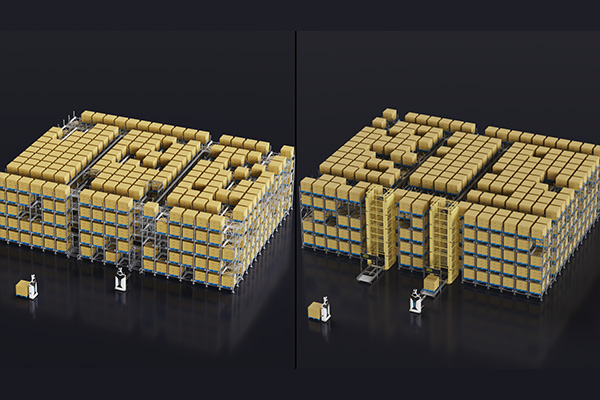
Dense storage decisions often come down to how the system behaves at the transfer point between horizontal and vertical movement. <Six-Way Shuttle System Leads the Shift from Machines to Robots in Dense Storage Automation> covers why robot-to-robot handoff changes buffer requirements in dense storage, which is exactly where inventory pressure builds in high-density pallet operations.
What Should You Confirm Before Pallet Automation Can Cut Inventory Pressure?
Pallet automation will not remove inventory pressure if the system is sized only for an average day. Most pressure comes from demand spikes, hybrid inbound and outbound shifts, and SKU proliferation. Before committing, we ask operations teams to confirm three things: pallet dimensions and load class, expected pallet moves per shift at peak, and the current delay between dock arrival and system putaway. Those numbers determine whether a four-way shuttle, a six-way shuttle, or a narrow aisle robot is the right boundary. After the mechanical system is selected, the software handshake is the next decision point. If your inventory pressure is tied to order cut-offs or production line sequencing, send your pallet profile, shift pattern, and storage density target to [email protected] or call (+86)-19941778955. We will use that data to model where the pallets queue and which equipment removes the constraint, before you commit to racking or layout changes.
What Do Buyers Still Ask About Pallet Automation and Inventory Pressure?
Does pallet automation reduce pressure if my inventory turnover is already high?
Yes, but the benefit shows up as a shorter order cycle time, not just less inventory. High turnover warehouses already hold little stock, so the pressure comes from the speed at which inbound pallets become outbound picks. Automated storage and retrieval moves pallets directly from receiving to a live pickable location and releases tasks without waiting for a forklift. A four-way shuttle system works best here when WMS and WCS rules are configured to reallocate fast moving SKUs to the location closest to the pick face. Pallet automation alone may not reduce inventory days if the purchasing policy still carries large order quantities.
Can a four-way shuttle system reduce inventory pressure in an existing warehouse?
It depends on building constraints, but the two that matter most are aisle width and floor flatness. With a U-bot omnidirectional stacker robot, existing narrow aisle warehouses with aisles as small as 2100 mm can be converted without a full racking rebuild. If the roof height does not fit an H-bot vertical lift, a four-way shuttle can still increase pallet density in the lower levels. We evaluate current floor joints and the column grid before recommending the automation path because the robot’s positioning accuracy and the racking tolerances must match.
What is the first sign that a warehouse has too much inventory pressure?
It is usually not a full warehouse. It is a warehouse where pallets keep moving into staging but do not reach a pickable location. Operators call it inventory that has nowhere to go, but the real issue is a slow putaway decision. When receiving queues start blocking outbound docks, inventory pressure has already shifted from a space problem to a flow problem. That is when automation should be considered as a release mechanism, not just as a way to add racking.
How do I tell whether software or robot throughput is causing the pressure?
In pallet automation projects, we look at task release latency before we look at robot speed. If a shuttle waits after a pallet arrives at a transfer point, the bottleneck is in the WCS or RCS logic. If tasks release immediately but shuttles queue behind the vertical lift, the bottleneck is in equipment throughput or lift capacity. That distinction changes the fix: one is a configuration change, the other may require an additional H-bot or a different wave planning rule. Share your pallet profile, shift data, and current queue locations at [email protected] or call (+86)-19941778955, and we will confirm where your warehouse reaches its actual constraint before you order equipment.
If you’re interested, check out these related articles:
Six-Way Shuttle Powers Dense Storage: Breaking Space Limitations
Smart Warehousing Starts Here: Cost-Effective Four-Way Shuttle Systems
Six-Way Shuttle Drives Warehouse Upgrades: Building an Intelligent Automatic 3D Warehouse
PTP Intelligent Warehouse Software Empowers Enterprises for Smart Upgrades
Software-Driven Hardware: Six-Way Shuttle Maximizes Warehouse Efficiency