Robotics in assembly line supply and storage earns its cost when the binding constraint is timing and repetition rather than handling speed. A plant gains most from automating the two loops that tie a line to its inventory: replenishment from bulk storage to the line, and transfer of work in progress and finished goods back into storage. Both loops run on the takt that governs the line, so a fast robot fed by an unstable container or an incomplete order stream will simply wait. The useful engineering question is where the interface between those loops should be automated, and where a person still does the job better.
Where Robotics Sits in the Assembly Line Supply Chain
An assembly line does not consume pallets. It consumes a specific part at a specific station inside a takt window, and that single fact separates line-side supply automation from general warehouse automation. It also explains a common pattern: a plant can run a heavily automated central warehouse and still move material to its stations by hand, because the two problems were never the same problem.
Two loops connect the line to its inventory. The first moves material forward, from bulk storage through a line-side supermarket to the stations that consume it. The second moves material back, taking work in progress, empty containers and finished goods away from the line into storage or dispatch. Automation usually starts in one loop and spreads to the other, and starting in the wrong one is the most expensive way to learn the difference.
| Flow | What moves | Typical robot role | What constrains it |
|---|---|---|---|
| Bulk replenishment | Full pallets from high racking to the line-side supermarket | Shuttle or stacker robots moving pallet loads on a fixed interval | Storage density and how often the line calls for more |
| Sequenced or kitted supply | Mixed containers in the order the line consumes them | Mobile robots or tugger trains delivering kits and sequenced sets | Order stability and how well containers present at the station |
| Work in progress | Partly built assemblies between stations and buffers | Short conveyors or mobile robots serving defined buffers | Buffer size and the frequency of rework loops |
| Finished goods return | Completed units from the end of the line into storage | Pallet robots or shuttles feeding outbound storage | The outbound schedule and the quality of the load build |
The four flows do not carry equal risk. A missed replenishment stops the line, a missed kit delivery pushes a station into working around the shortage, and a missed finished goods transfer only fills the end-of-line buffer. Ranking the flows by the cost of a delay is the first decision a project makes, and it usually points to a buffer decision before it points to a robot decision.
What Line-Side Supply Automation Must Deliver
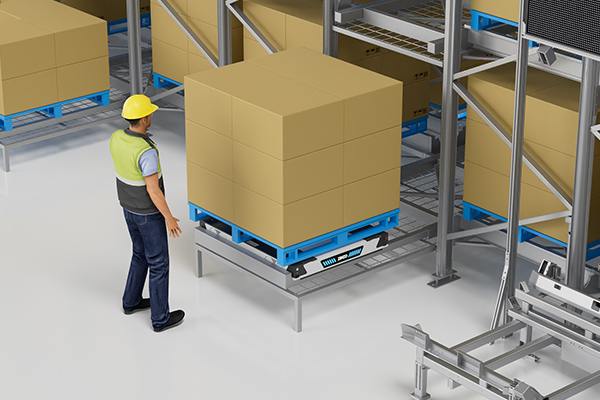
Line-side automation has to satisfy four conditions that a general warehouse project can ignore: arrival inside the takt window, presentation the operator or robot can use without reorienting the load, a buffer small enough to fit beside the line, and a replenishment signal that fires early enough to refill that buffer.
The takt window is the hard one. Material that arrives late stops the line; material that arrives early consumes floor space the line does not have. The two errors look symmetric and are not. Early arrivals accumulate as line-side stock that hides shortages until the floor is full, while late arrivals appear as a stoppage that every planner remembers. A workable design accepts a deliberate buffer of perhaps twenty to forty minutes of consumption and treats anything beyond that as a planning error rather than a safety margin.
Container presentation decides whether a robot can serve a station at all. Pallets with overhanging loads, totes without a repeatable pick face, and kits assembled in inconsistent sequence all push the work back to a person. Before specifying a vehicle, audit the containers that actually reach the line, including the damaged ones, because those are the loads the robot will meet on a bad shift.
The replenishment signal is where most projects fail quietly. A pull signal triggered by an empty lane is already late; a signal triggered by every pick fires so often that the robot spends its shift in traffic near the busiest stations. The workable middle ground uses consumption at the station, a defined minimum on the line-side lane, and a travel time allowance measured on the real route rather than the shortest path. On a line where several stations draw from the same supermarket, the signal also needs a priority rule, or the loudest station will starve the others.
Dense Storage Behind the Line
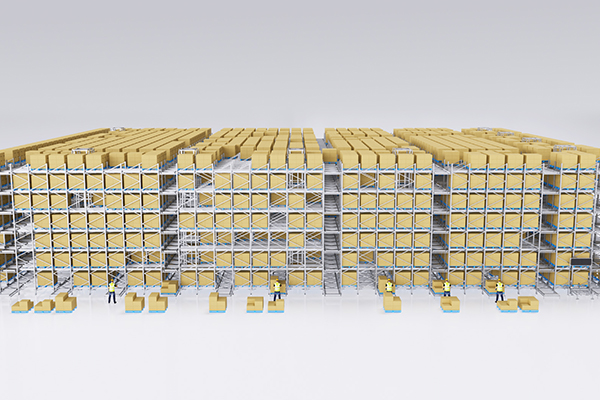
The storage behind an assembly line has a different job from a distribution warehouse. It holds a narrow range of part numbers at high depth, it replenishes small quantities frequently, and it often sits in the same building as the line, which makes every square metre of aisle a direct cost against production space.
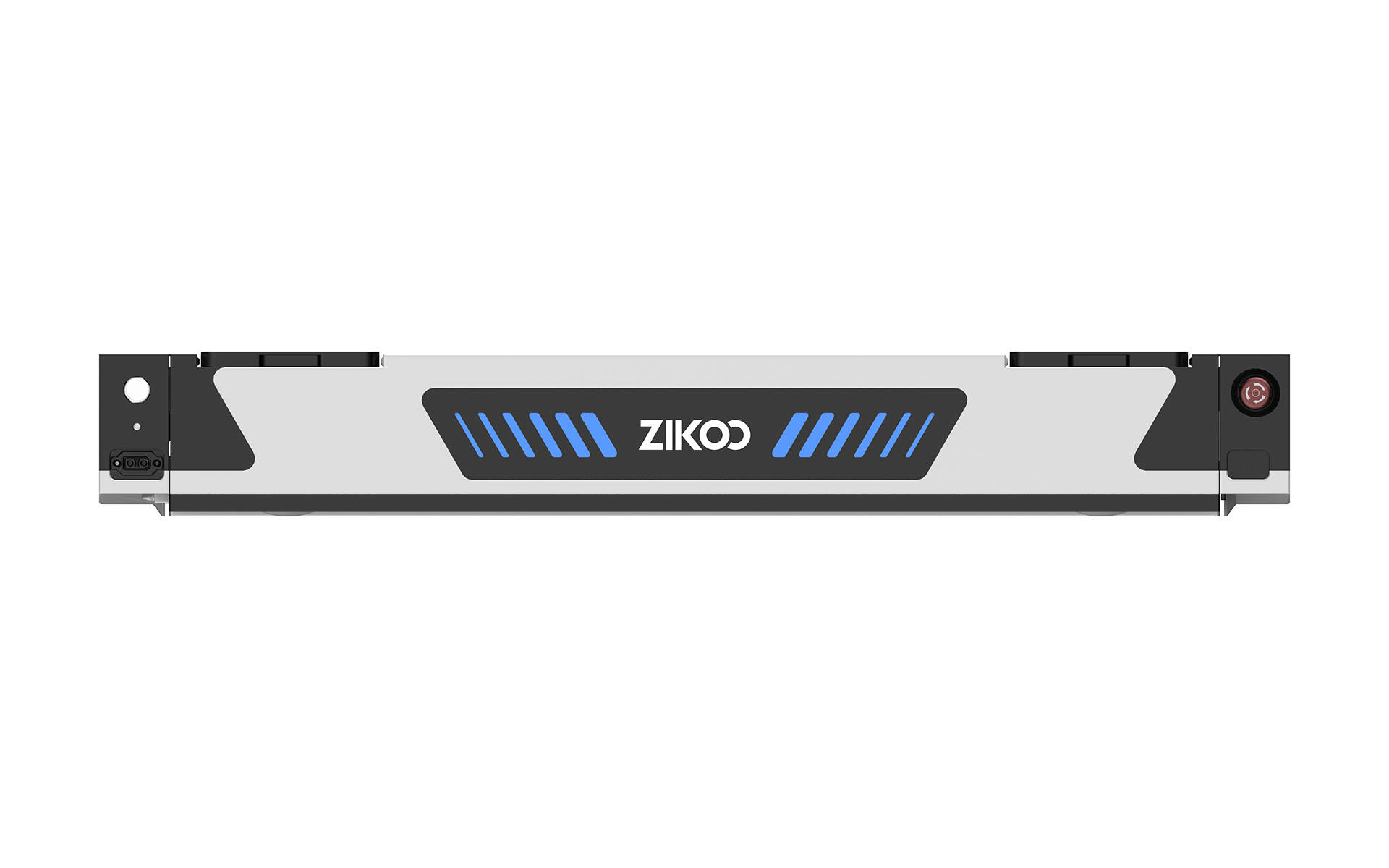
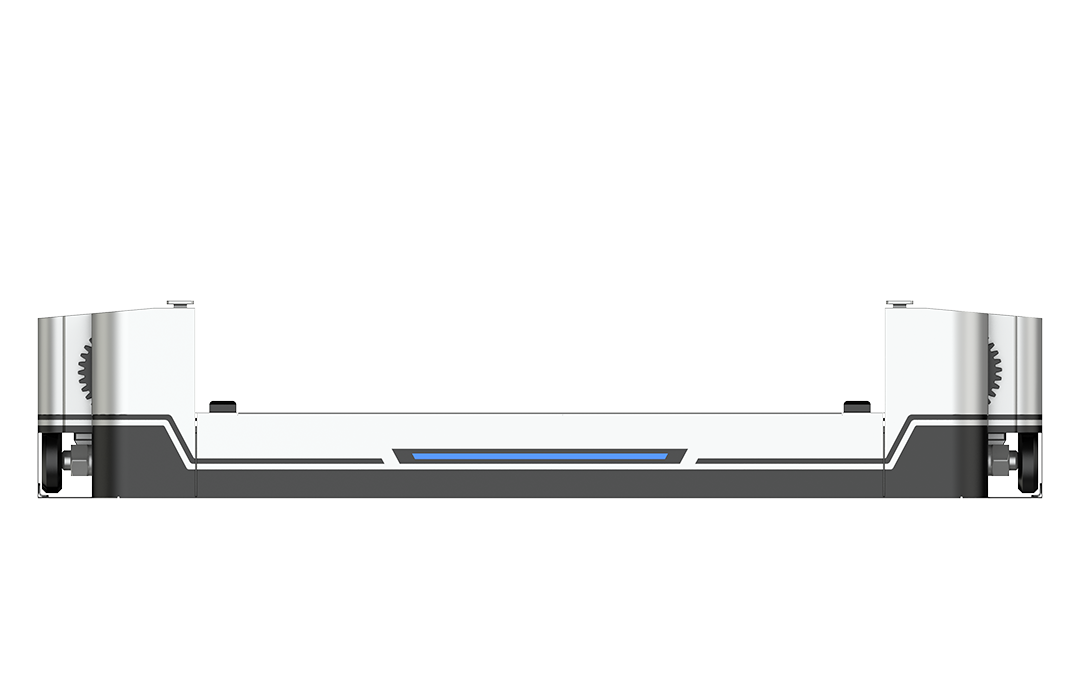
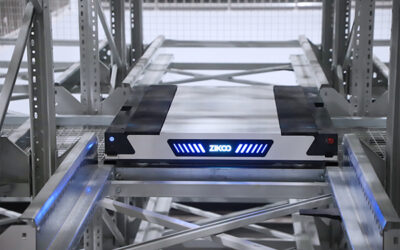
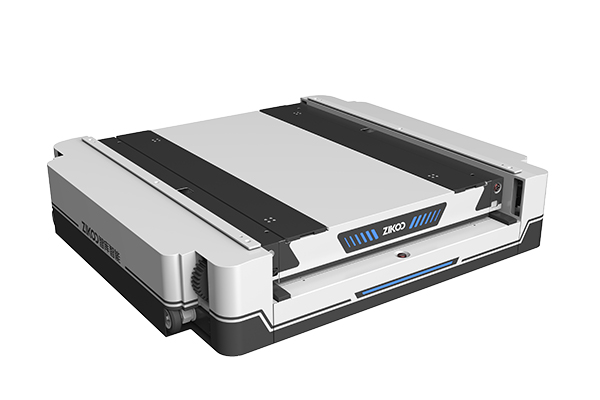
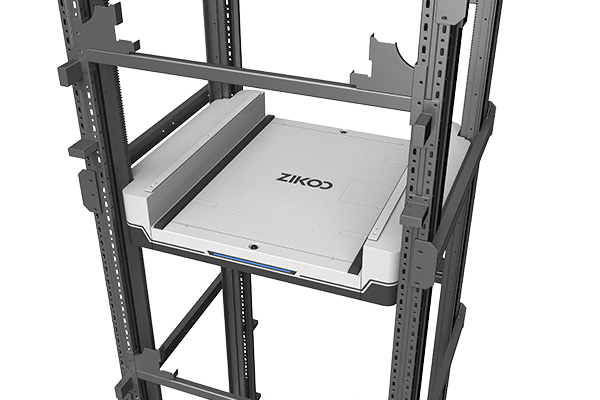
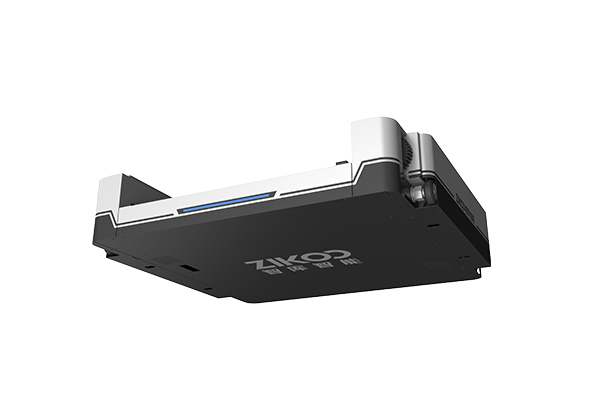
A four-way shuttle changes the geometry of that storage. The vehicle runs on rails inside a rack grid, travels under the pallet it carries, and moves in two horizontal directions at any level, so the storage block needs no working aisle per level. In the Zikoo R-bot range the body is 125 mm thick, rated loads run from 1200 kg on the standard model to 2000 kg on the large pallet model, and loaded travel reaches 1.2 m/s on the standard types. Those figures matter less as specifications than as consequences: a thin body allows more storage levels under a fixed roof, and a loaded speed sets how many replenishment trips one vehicle can complete in a shift.
Vertical transfer closes the remaining gap. A bidirectional vertical shuttle takes a pallet between levels and, working with horizontal shuttles, produces the six-direction network that dense manufacturing storage depends on. Zikoo H-bot units are rated at 1800 kg with a positioning accuracy of about 1 mm, which is the order of accuracy a rack interface needs when the pallet must land inside a location rather than on a floor.
The density gain has a cost that planners should state openly. When every level is a storage level, the vehicles share a smaller number of transfer points, and throughput becomes sensitive to congestion at those points rather than to vehicle speed. A plant that adds storage depth without adding transfer capacity gets a fuller warehouse and a slower line.
Dense storage and the robot fleet that serves it are usually designed as one system rather than bought as two. <Six-Way Shuttle System Leads the Shift from Machines to Robots in Dense Storage Automation> covers how that shift changes the way storage capacity is planned.
Matching the Robot to the Load, the Aisle and the Lift Height
Vehicle selection follows the layout, not the other way round. Three profiles cover most assembly line work, and each one stops paying off at a different point.
| Vehicle profile | Load and space profile | Best fit | Where it stops paying off |
|---|---|---|---|
| Four-way pallet shuttle | Pallets up to about 2 t in a rack grid with no working aisles | High-density raw material and finished goods storage beside the line | When the line needs frequent single-pallet access at many points |
| Vertical bidirectional shuttle | Pallet transfer between levels, positioning to about 1 mm | Connecting storage levels and forming a multi-direction network | When the building has no height to justify multi-level storage |
| Omnidirectional stacker | Aisles from about 2100 mm, lift to 8 m, loads around 1 t | Retrofitted buildings with existing racking and narrow aisles | When the floor cannot carry the machine or the aisle cannot be cleared |
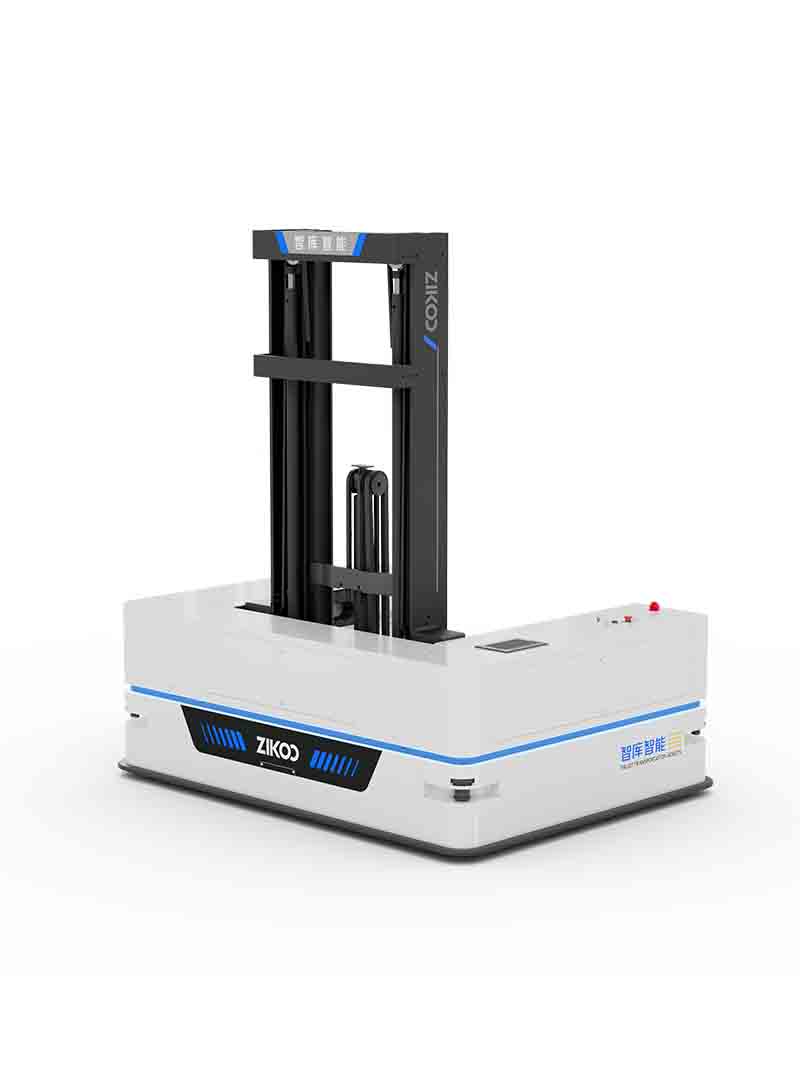
The narrow-aisle profile deserves attention in brownfield plants, because it is often the only option that fits an existing building. A Zikoo U-bot, for example, works in a minimum aisle of 2100 mm, lifts 1000 kg to heights of 4500, 6000 or 8000 mm depending on the model, and holds driving positioning to about 10 mm. The last figure is the one to question in a specification review: rack tolerances, floor flatness and pallet condition all consume part of that allowance before the fork ever reaches the beam.
Precision claims need the same scrutiny at the other end. A vertical shuttle quoted at 1 mm is describing its own positioning, not the accuracy of the rack it enters. If the racking was installed to a looser tolerance, the vehicle will place the pallet accurately in the wrong place, and the failure will appear as a recurring fault rather than a design error.
Software Orchestration Decides Whether the Hardware Earns Its Cost
A robot fleet without an order stream is a set of parked machines. The software layer converts a production schedule into transport orders, sequences them against the line’s consumption, and decides which vehicle takes which task. In most plants that layer is not one system: a warehouse management system holds inventory, a warehouse execution system sequences work, a control system drives the equipment, and a robot control system dispatches individual vehicles.
The interface to manufacturing execution matters more than the internal layering. If the line schedule changes at 06:00 and the transport orders are generated from a batch plan built the night before, the fleet will deliver the previous shift’s sequence with high precision. Integration that reads consumption and schedule changes in near real time is what makes frequent small replenishment possible at all.
Exception handling is the second test. A blocked aisle, a pallet that fails a dimension check, or a station that stops mid-shift all produce a decision: hold, reroute or escalate. Software that hides those events behind an alarm leaves the operator to solve them by walking the floor.
The transport layer and the storage layer share one schedule, and a change in either propagates to the other within the same shift. <PTP Intelligent Warehousing Platform: Building a Flexible and Smart Logistics Ecosystem> covers how that coordination is structured across warehouse, execution and robot control functions.
Where Assembly Line Robotics Does Not Pay Off
Automation is a poor fit for some line profiles, and saying so early saves a project. The clearest case is a stable, low-mix line running long campaigns with few part numbers and a replenishment interval measured in hours. A tugger train or a scheduled forklift round already meets that demand, and the capital is better spent on the process constraint.
A second case is high container variability. If pallets arrive with inconsistent load heights, overhang or damaged corners, every one of those defects becomes a robot exception, and the exception rate, not the cycle time, sets the labour requirement. Manual handling absorbs that variability cheaply.
A third case is a plant without takt discipline. Robotics does not create a stable consumption rhythm; it amplifies whatever rhythm already exists. A line whose schedule changes several times a shift will keep the fleet reacting rather than sequencing, and the utilisation figures will look poor for reasons no vehicle upgrade can fix.
The fourth case is scale. Storage automation carries fixed costs in controls, commissioning and spares that a small line-side buffer cannot amortise. A plant handling a few hundred pallet movements a week may find a semi-automated shuttle arrangement or a conventional narrow-aisle truck the more rational choice, even though the fully automated version looks better on a layout drawing.
Cost per stored pallet position and cost per completed move behave differently as a system grows. <Smart Warehousing Starts Here: Cost-Effective Four-Way Shuttle Systems> covers how the economics of four-way shuttle storage change with scale and configuration.
A Pre-Project Check List for Line-Side Robotics
The checks below decide more about the project outcome than the vehicle datasheet does. Each one produces a number or a document that a supplier can be held to.
| Check | What to measure | What a usable result contains |
|---|---|---|
| Takt profile | Consumption per station per shift, and the variation between shifts | A distribution rather than an average, with the peak shift identified |
| Container audit | Dimensions, weight, load condition and damage rate of every container type reaching the line | A short list of containers that need standardisation before automation |
| Replenishment rate | Replenishment events per shift per station at the buffer size you intend to run | Events per hour, which sets vehicle count and transfer point capacity |
| Exception map | Every stop, shortage, quality hold and rework loop observed over a month | The share of exceptions the robot must handle versus escalate |
| Interface definition | Data exchanged with the existing WMS, MES and ERP, and at what interval | A named message, owner and update frequency for each interface |
| Acceptance test | The throughput, accuracy and availability the supplier must demonstrate | Test conditions, load mix, duration and the measurement method |
The acceptance test is the item most often left vague and the one that decides whether the project closes cleanly. A test run on a clean shift with a full fleet, standard containers and no schedule changes proves very little about a Monday morning with a damaged pallet and a changed build sequence. Writing the test around the peak shift, the known bad containers and a defined exception rate produces a result both sides can interpret.
Send the Line Data Before You Compare Robots
A supplier can size a line-side system only from the numbers your line already produces. Send the takt time and shift pattern, the unit loads with dimensions and weights, the container types that reach the line, the available line-side buffer footprint, replenishment events per shift, the interfaces you run between WMS, MES and ERP, and any temperature or cleanliness condition that constrains the equipment. With those, Zikoo Smart Technology Co., Ltd can indicate which vehicle and storage configuration fits the building and where the design still needs site verification. Email [email protected] or call (+86)-19941778955.
FAQ
Is line-side robotics worth it for a plant with stable, low-mix production?
Usually not at first. A stable line with long campaigns and few part numbers is already served by scheduled forklift rounds or a tugger train, and the remaining cost sits in the process rather than in material handling. Revisit the question when replenishment frequency rises, when the line-side footprint becomes the constraint, or when a second shift doubles the number of moves without doubling the space.
How is line-side robotics different from a warehouse AS/RS?
The storage equipment can be similar; the control problem is not. A warehouse system optimises storage density and order fulfilment across a building, while a line-side system must hit takt windows, present containers for a specific station and respond to schedule changes within a shift. That is why a working central warehouse does not automatically produce a working line-side supply design.
What container standard do I need before automating line supply?
You need containers the vehicle can pick and place without adjustment: consistent outer dimensions, a defined pick face, controlled load height, no overhang beyond the pallet footprint, and a damage rate low enough that exceptions do not dominate the shift. Audit the containers that actually arrive, including damaged ones, before writing the specification.
Can an existing assembly line be retrofitted without stopping production?
It can be staged, but not without disruption. Most retrofits separate the storage build from the line-side change, commission the fleet against a temporary buffer, and migrate stations in groups during planned shutdowns. The decisive planning input is the number of stations that can switch in one window, not the vehicle type.
How should a line-side robotics project be measured after go-live?
Measure the metrics the project was justified on: replenishment events completed inside the takt window, line stoppages caused by material shortage, exception rate per shift, and vehicle availability. A throughput figure alone hides the difference between a fleet that is fast and a fleet that is reliable on the shift that matters.
If you’re interested, check out these related articles:
Six-Way Shuttle Empowers 3PL Providers to Build Next-Generation Smart Logistics Hubs
Smart Warehousing Starts Here: Cost-Effective Four-Way Shuttle Systems
Six-Way Shuttle: Pioneering the Future of Smart Warehousing
Revolutionizing Cold Chain Logistics: Zikoo Robotics Six-Way Shuttle Powers High-Density, High-Efficiency Warehousing