Four-way shuttle forklift replacement is not a theoretical question anymore; it is a concrete operational decision that warehouse managers across industries are evaluating. The metric that matters is whether a coordinated shuttle system can match or exceed the material flow capacity of a conventional forklift fleet while reducing labor dependency and improving storage density. I will focus on the practical prerequisites that separate successful forklift-free facilities from those where a hybrid model still makes sense, drawing from system designs we have deployed in cold chain, manufacturing, and third-party logistics environments.
When Can Four-Way Shuttles Fully Replace Forklifts?
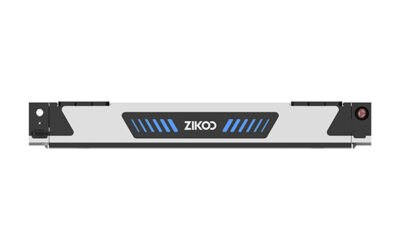
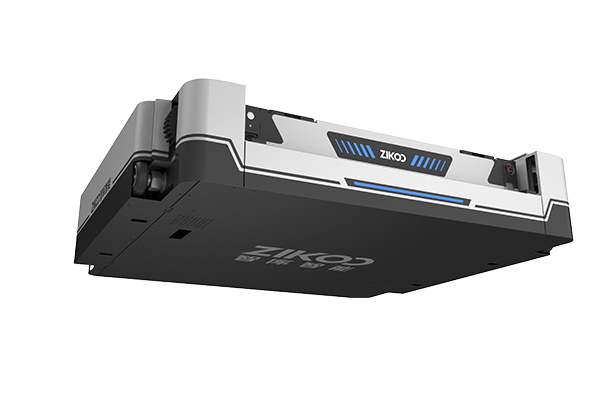
Full forklift replacement becomes feasible when a warehouse consistently moves pallets through a structured racking layout and operates at a volume that justifies the investment. The shuttle system works best in high-density, high-throughput environments where every square meter of floor space counts. Cold chain operations are a prime candidate: at –18°C or below, forklift driver productivity drops sharply, while the R-bot four-way shuttle with an optional low‑temperature lithium battery sustains 7–8 hours of continuous operation without exposing personnel to extreme conditions.
There are also clear boundaries. A narrow‑aisle warehouse with a ceiling under 6 meters and fewer than 400 pallet positions rarely achieves a competitive payback. Similarly, if the facility handles irregular oversized pallets or operates only one shift with low throughput, the flexibility of a small forklift fleet may remain the better choice. The table below summarizes the main operational differences that define the replacement threshold.
| Factor | Conventional Forklift Fleet | Four‑Way Shuttle + Elevator System |
|---|---|---|
| Storage density | 50–60% rack utilization | 85–95% dense storage utilization |
| Labor per shift | 1 operator per truck | 1 operator supervising 4–6 shuttles |
| Throughput consistency | Dependent on operator fatigue | Consistent 1.2–1.6 m/s per shuttle, 0.5–1.0 m/s vertical |
| Cold chain suitability | Limited by operator exposure | -25°C continuous operation, no operator presence required |
| Peak handling | Add temporary labor | Dynamic shuttle dispatch handles spikes |
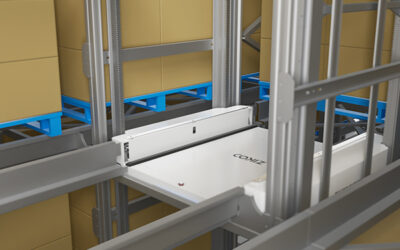
The R-bot achieves 1.6 m/s empty and 1.2 m/s under a 1,500 kg load, while the H-bot vertical shuttle moves pallets between levels at 1 m/s. In a properly laid out grid, this combination moves pallets point‑to‑point faster than a forklift that must navigate long travel aisles.
What Operational Prerequisites Must Be Met?
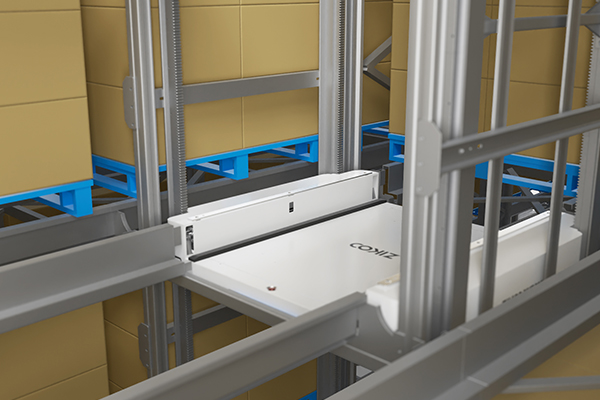
A forklift‑free warehouse is not simply a case of removing trucks and placing shuttles onto existing racking. The building itself must meet specific engineering parameters. Floor flatness is the first gatekeeper: deviations beyond ±2 mm over 2 meters interfere with shuttle alignment and rail‑based guidance. The slab must be assessed ahead of any layout design. Ceiling height matters, too; while the R-bot body is only 125 mm thick, the supporting rack structure and H‑bot elevator lift height define the achievable storage density. Typical installations we configure start at 8‑meter clear height, though we have deployed systems in 6‑meter retrofits where the client accepted a lower storage row count.
Beyond the physical envelope, the control software stack is non‑negotiable. A forklift relies on a human to decide where to put a pallet; a shuttle system needs a WMS that maintains real‑time inventory location and a WCS that allocates shuttle tasks without conflict. Our PTP Smart Warehouse Software platform integrates WMS, WES, WCS, and RCS layers on a single backbone. In projects where the client attempts to retrofit the automation layer onto an incomplete software stack, we see the same pattern: aisle‑level throughput caps out at roughly 60% of design capacity due to task‑queuing latency.
If your facility’s racking configuration or ceiling height raises questions, it is worth confirming early. Share your layout drawing with us at [email protected] and we will provide a preliminary compatibility assessment before any capital decisions are made.
How Do Shuttle System Costs Compare to Forklift Fleets?
Comparing the cost of a four‑way shuttle system to a forklift fleet requires looking at total ownership over a six‑ to eight‑year horizon, not just the procurement line item. The upfront capital for a shuttle grid, racking reinforcement, and software is higher; a four‑aisle, 2,000‑pallet system with four R‑bots, two H‑bot elevators, and full WMS/WCS integration typically demands a larger initial check than purchasing six to eight electric counterbalance trucks. The economics shift when the operational column is added.
Forklift costs leak through multiple channels. Operator turnover in many markets runs above 30% annually, each replacement requiring hire costs, training, and a productivity dip. Safety incidents generate hidden costs far beyond insurance: a single rack impact can damage structural uprights and trigger a rack audit. Pallet and product damage is hard to escape when forks interact with load beams thousands of times per month. Maintenance, too, follows a predictable curve with aging lead‑acid batteries and motor rebuilds after 10,000‑plus hours.
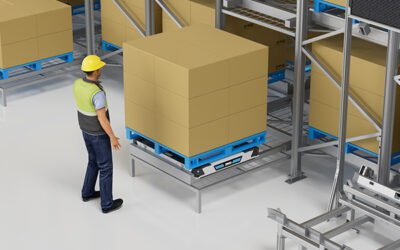
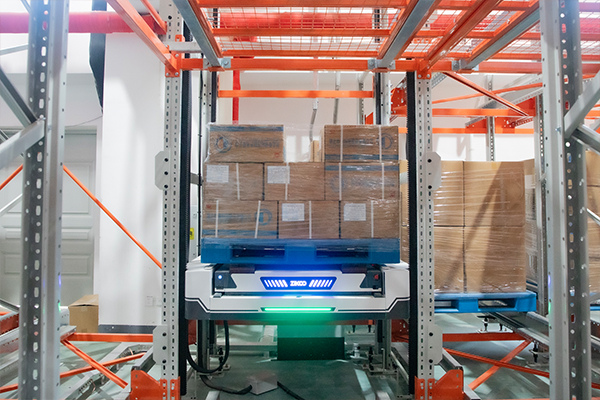
A shuttle system replaces variable operating cost with fixed‑profile maintenance. Lithium battery packs on the R‑bot are designed for full‑shift operation with automated charging during idle cycles. Wear components are limited to drive wheels and guide rollers, replaced on a scheduled interval rather than a reactive basis. Our project data across multiple industries shows that labor cost alone typically falls by 60–70% when shuttles handle the repetitive pallet moves—one operator overseeing the exception dashboard replaces six or more forklift drivers per shift.
Total cost of ownership visibility is the primary factor to assess before committing to forklift replacement. If you have your current fleet cost data available, a like‑for‑like comparison can be built within a week.
What Does the Transition Process Look Like?
Moving from a forklift‑dependent operation to a shuttle‑based system does not require a year‑long shutdown. We structure projects in phases that keep outbound shipments running; the first phase usually converts one or two high‑velocity racking aisles to shuttle lanes while forklifts continue to service the remaining floor area. This mixed operation is made practical by the U‑bot omnidirectional stacker robot, which needs an aisle width of only 2,100 mm and can operate in the same footprint as reach trucks. The U‑bot handles the high‑density storage on the shuttle side while forklifts manage bulk staging and oversized loads until the full transition is warranted.
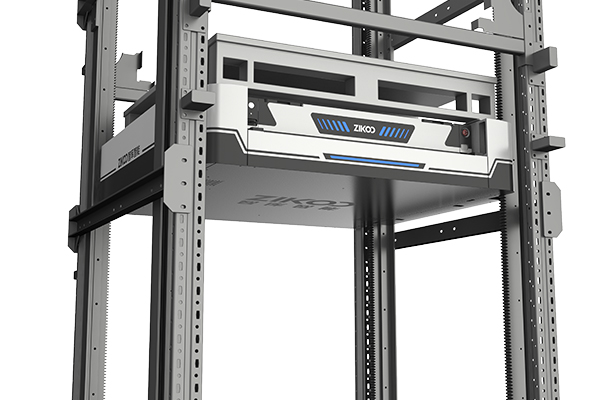
Retrofitting an existing facility changes the engineering sequence. Racking must be re‑qualified for shuttle rail loading, floor‑anchoring points installed, and data cabling routed for access points. Zikoo’s six‑way shuttle solution, which combines R‑bot horizontal movement with H‑bot vertical lifts, fits within standard pallet rack uprights, so a complete rebuild of the rack structure is not required. The typical conversion of one aisle from forklift to full shuttle operation takes six to eight weeks from rack preparation to system go‑live, assuming the WMS integration is not starting from zero.
The most common hesitation we encounter is the fear that a partially automated warehouse creates operational chaos during the transition. The reality is that a clear cutover schedule, backed by a software platform that tracks both manual and automated transfers in the same inventory view, makes mixed operations surprisingly stable.
How Scalable and Future‑Proof Are Shuttle Systems?
One of the structural advantages of a four‑way shuttle architecture is that capacity scales in discrete, predictable units: add a shuttle to increase horizontal throughput, add an H‑bot to raise vertical capacity, extend the racking lane to grow storage depth. Unlike a fixed‑aisle crane AS/RS where the initial design dictates a hard throughput ceiling, a shuttle grid can start modestly and expand over two or three years without requiring a greenfield build.
This modularity proves especially useful in cold chain and new energy sectors. The R‑bot cold chain configuration uses a special PCBA coating that handles condensation and high humidity, and the lithium battery is rated for consistent discharge at –25°C. When a frozen goods facility needs to add a temperature‑controlled buffer zone, we can extend the lane and deploy additional shuttles without touching the existing operational area. The same flexibility applies to SKU growth: a grid that starts with 2,000 pallet positions can be extended to 4,000 or 6,000 by lengthening rails and increasing the shuttle fleet proportionally.
There is a software dependency here that cannot be ignored. Scalability is only as good as the dispatch algorithm. Our PTP platform recalculates optimum shuttle routing when new units join the fleet; a simple sequential allocation would create dead‑heading bottlenecks at around eight to ten shuttles per level. We have validated dynamic dispatch in projects handling over 800 pallet moves per hour across 3,200 positions, which gives a tangible ceiling to plan against.
For a long‑term automation partner, look for the ability to provide a capacity roadmap that shows exactly how many shuttles and lifts are needed at each volume threshold—not just a generic promise of modularity.
Questions About Replacing Forklifts with Four‑Way Shuttles
How long does it take to implement a four‑way shuttle system from decision to go‑live?
The full cycle depends on building readiness and software maturity. For a greenfield project with pre‑prepared slab and racks, the shuttle system installation and commissioning typically takes 8–10 weeks. Retrofitting an existing facility adds 4–6 weeks for rack reinforcement and floor preparation. The longer pole in the tent is WMS integration; if the warehouse already uses a compatible WMS with open API, integration can be done in 6–8 weeks. In projects where we provide the full PTP software stack from day one, the combined schedule often lands between 12 and 16 weeks for a retrofit and 8–10 weeks for new builds.
Can a forklift‑free warehouse handle peak seasons without issues?
Yes, and this is one area where the shuttle system outperforms a human fleet. Peak‑season pressure on forklift operations usually means adding temporary labor, which brings quality and safety risk. A shuttle grid handles surges by activating all available shuttles and running extended charging cycles. With the R‑bot operating 8 hours on a full charge and auto‑charging during low‑demand windows, a four‑shuttle‑per‑level configuration can maintain near‑continuous coverage. The real bottleneck becomes the outbound conveyor‑to‑dock staging, not the shuttle grid itself.
What happens if a shuttle fails—does the whole system stop?
No. The WCS manages redundancy by design. When a single shuttle reports a fault and exits the active pool, the controller re‑allocates its pending tasks to the remaining shuttles in the same level. Throughput drops by the proportional capacity of that shuttle—typically 20–25% on a four‑shuttle level—but the system continues running. The failed shuttle is guided to a maintenance bay without bringing down the aisle. This is why we size shuttle fleets with at least N+1 redundancy for mission‑critical lanes.
Are four‑way shuttle systems more expensive than simply adding more forklifts?
If the comparison is a single‑shift operation with low labor cost and a simple drive‑in rack, adding a forklift is almost certainly cheaper in year one. The equation changes when a facility runs two or three shifts, faces labor scarcity, or operates in cold storage where driver productivity drops to 60% of ambient levels. In those cases, the total cost of ownership over five years tips in favor of the shuttle system—not from the hardware alone, but from the permanent reduction in labor headcount and the 30–50% gain in storage density. The fastest way to get an accurate picture is to benchmark your current fleet cost against a configured shuttle proposal. Share your throughput data and warehouse dimensions at [email protected] or call (+86)-19941778955, and we will build a detailed comparison that reflects your real operating conditions.
If you’re interested, check out these related articles:
Six-Way Shuttle: The Smart Warehousing Tool for Cost Reduction and Efficiency 2
Six-Way Shuttle: Empowering Industries to Embrace Smart Warehousing
Standardization Empowers Global Delivery: Zikoo Robotics Six-Way Shuttle Expands Overseas