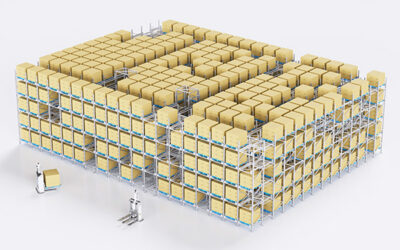
A pallet shuttle system combines a motorized shuttle car with deep rack lanes to store pallets several positions behind the aisle. The shuttle travels on rails inside the lane, lifts a pallet, and moves it between the aisle face and a deeper storage location. Shuttle racking removes the need for a forklift or crane to enter every lane, which allows more rack positions in the same floor area. The tradeoff is lane-dependent access: the farther a pallet sits from the aisle, the longer the retrieval path and the more the system depends on pallet quality and SKU depth. The right architecture depends on pallet type, throughput per lane, building height, software integration, and the desired level of automation.
How a Pallet Shuttle System Works in a Deep-Lane Layout
In a basic lane-shuttle arrangement, shuttle rails sit inside the rack beam level, and the shuttle is placed into the lane by a forklift or a dedicated lifting device. The shuttle moves beneath the pallet, raises its lift platform a short distance, and carries the pallet along the lane. At the front position, the forklift or transfer station can place or retrieve the pallet while the shuttle returns to the next task.
This mechanism makes lane depth practical. A lane can hold several pallets of the same SKU behind one aisle face, so a single aisle opening serves many pallet positions. Load detection sensors, mechanical centering guides, and shuttle positioning checks prevent the vehicle from driving into an incorrectly placed pallet. Those controls are important because the shuttle operates in a space where the forklift operator cannot see or correct every motion.
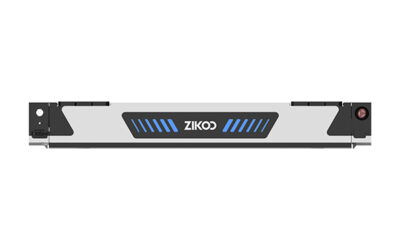
When storage extends over multiple levels, a vertical transfer device moves the shuttle between rack levels. The H-bot vertical bidirectional shuttle is designed for this job; it occupies one storage location and forms the vertical leg of a dense storage network.
Its positioning accuracy of ±1 mm reduces the alignment errors that could disturb shuttle entry at height. Pallet movement then becomes a sequence of transfers rather than a single vehicle traveling the full distance from aisle to storage position.
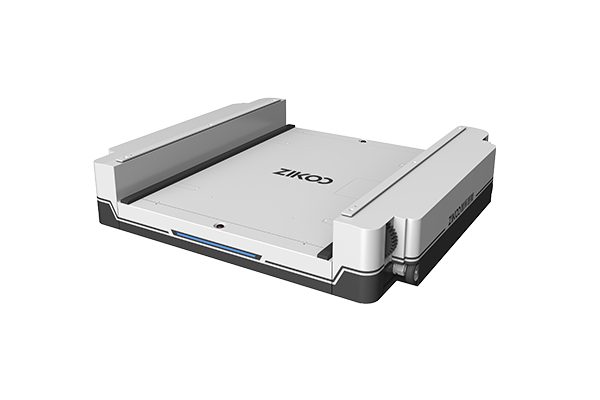
Two movement types appear in shuttle racking. A two-way pallet shuttle travels only along the lane, while a four-way shuttle can move across rails inside a storage layer and change lanes under software control. Four-way movement is useful when the warehouse needs to reduce transfer equipment or serve multiple lane depths from one shuttle fleet.
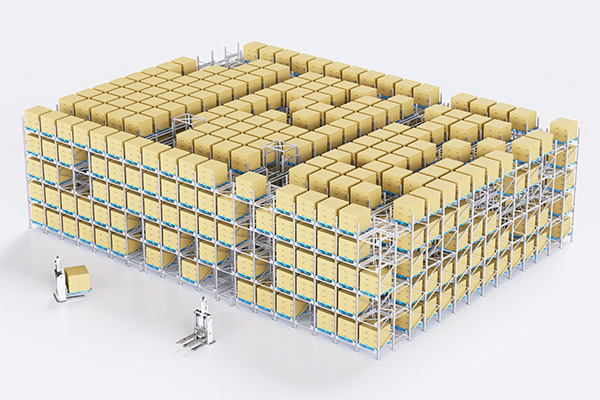
Deep-lane racking may combine a two-way shuttle in a fixed lane or a four-way shuttle that also changes lanes within a storage layer. <Smart Storage Revolution: Comprehensive Overview of Four-Way Shuttle Systems for Automatic 3D Warehouses> covers how four-way shuttle systems extend that movement across an automatic 3D warehouse.
Shuttle Racking Configurations for Deep-Lane Storage
Shuttle racking is not a single layout. The most important choice is whether the shuttle is bound to one lane or can move within a storage level. Fixed-lane shuttle racking is simpler and usually lower in cost. Four-way shuttle racking uses rails on orthogonal axes and lets the shuttle move between lanes and across a layer. Adding a vertical lift creates a six-way shuttle arrangement, where the shuttle can move forward, backward, left, right, up and down through the system.
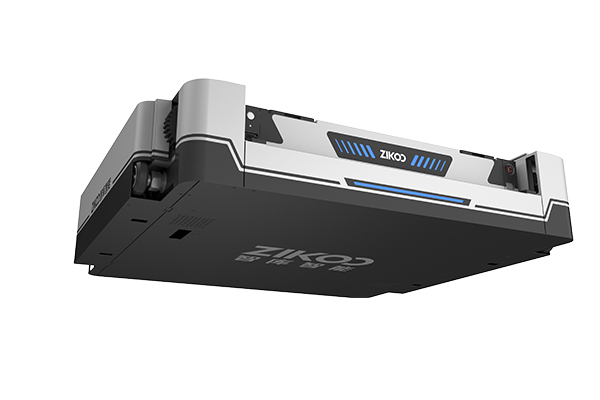
The R-bot Four-way Shuttle model range illustrates the pallet and load factors that affect lane design.
| Model | Rated load | Body height | Loaded speed | Pallet compatibility |
|---|---|---|---|---|
| R1200B standard | 1,200 kg | 125 mm | 1.2 m/s | 1200 × 800-1000 mm |
| R1200A American | 1,200 kg | 125 mm | 1.2 m/s | 1016 × 1219 mm |
| R1500J Japanese | 1,500 kg | 125 mm | 1.2 m/s | 1100 × 1100 mm |
| R1500B heavy-duty | 1,500 kg | 125 mm | 1.2 m/s | 1200 mm pallet |
| R2000B heavy-duty large pallet | 2,000 kg | 150 mm | 1.0 m/s | 1400 mm pallet |
The shuttle height matters in dense racking because every body-height reduction saves vertical pitch and allows more beam levels in the same building. The 125 mm body height supports that density, while the heavy-duty large-pallet model uses a 150 mm height to handle a 2,000 kg rated load and a 1,400 mm pallet footprint. These are product dimensions, not layout conclusions: the rack must also account for rail height, beam depth, pallet deflection, and fire protection clearances.
When Deep-Lane Pallet Shuttle Storage Fits the Operation
Deep-lane pallet shuttle systems perform best when several pallets of the same SKU move through the warehouse together. That profile lets the system fill a lane without creating constant partial-lane movements. In a food or beverage operation with long production runs, the lane becomes an efficient pallet buffer. In a high-SKU e-commerce warehouse where each lane would hold many different SKUs, retrieval logic becomes more complex and the density advantage may not be worth the orchestration cost.
The following operating conditions usually support shuttle racking:
- Stable pallet dimensions and bottom boards
- Multiple pallets per SKU or batch
- Moderate throughput per lane
- Building height that can support dense rack levels
- A clear inbound and outbound flow behind one aisle face
- Room for shuttle charging, lift positions, and maintenance access
A deep-lane system is less suitable when the operation stores one pallet of many SKUs, when pallet condition is inconsistent, when very short shelf life requires strict first-expired-first-out movement, or when throughput per lane must be very high. These are not automatic failures. They are conditions that change the design, the software logic, or the expected return on investment.
For strict first-expired-first-out stock, the lane design must be explicit. Single-face shuttle racking often behaves as last-in-first-out unless software and lane depth are arranged for whole-lane batch rotation. If FIFO is non-negotiable, the buyer should verify the supplier’s retrieval sequence before accepting the layout.
Semi-Automatic and Fully Automatic Pallet Shuttle Systems
A semi-automatic system uses the shuttle inside the lane but relies on a forklift to move the shuttle between lanes and levels. This reduces capital cost and is practical when a few lanes can serve stable SKUs. A fully automatic system removes the forklift transfer step by adding lifts, conveyors or transfer cars that move the shuttle and pallets under warehouse control. It costs more, but it stabilizes throughput and avoids multiplying forklift movements as the rack grows.
| Factor | Semi-automatic pallet shuttle | Fully automatic pallet shuttle |
|---|---|---|
| Shuttle transfer | Forklift moves shuttle between lanes | Lift or transfer vehicle handles shuttle movement |
| Operator involvement | Forklift driver required at aisle face | Operators mainly manage exceptions |
| Workload stability | Varies with forklift availability | More stable under software control |
| Integration | Lower complexity | Requires WCS and shuttle controllers |
| Capital cost | Lower | Higher |
Fully automatic layouts often move from a flat vehicle to a multiple-axis robot.
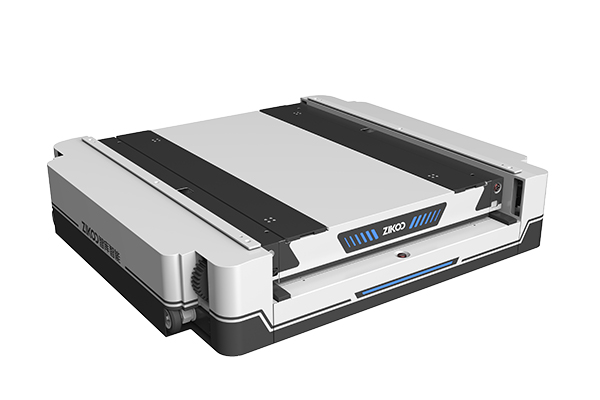
A six-way shuttle configuration combines a four-way shuttle with a vertical H-bot, so pallet movement is not limited to one level.
When a vertical lift is added, the combined system can transfer pallets horizontally and vertically without returning to an aisle forklift. <Six-Way Shuttle: The Dual-Engine Solution for High-D> covers how dual-engine shuttle and lift architectures balance density and throughput.
Throughput, Density and Space Planning Factors
Deep-lane storage improves cubic use, but lane depth changes throughput. A shuttle in a 20-deep lane must travel farther to reach the deepest pallet than in a 6-deep lane. This means calculating pallet moves per hour requires lane length, shuttle speed, lift transfer time, and the order sequencing logic together. The R-bot standard models travel at 1.6 m/s empty and 1.2 m/s loaded; the heavy-duty large-pallet model travels at 1.35 m/s empty and 1.0 m/s loaded. Those figures matter more when they are combined with lane length and dwell time than as a speed value alone.
The physical installation also determines whether the designed cycle time is safe. Floor flatness, rack alignment, and pallet consistency affect shuttle motion and load transfer. Deep rack lanes concentrate the effect of a small floor slope or an out-of-tolerance footplate, so laser and rail alignment checks need to be part of installation acceptance, not only the shuttle vendor’s factory test.
Low-temperature operation adds battery and material constraints. The cold-chain version of the R-bot uses a -25°C lithium battery and can run 6 to 8 hours continuously, with a charging port and coated PCBA for humidity. That does not mean every cold storage project can use the same battery without confirmation. The buyer should validate charging location, battery swap policy, condensation control, and the number of shifts before finalizing the shuttle count.
Dense racking reduces aisle count because multiple pallets sit behind one aisle face. The actual space saving depends on lane depth, building column spacing, lift positions, and whether the facility is new construction or a brownfield retrofit. A layout that looks dense on a drawing can lose capacity if the columns interrupt lane runs or the loading dock cannot keep up with the shuttle system.
WMS, WCS and Control System Integration
A deep-lane shuttle system is a materials handling subsystem inside a wider execution stack. WMS owns inventory and order demand; WCS turns those order lines into missions; the shuttle controller executes motion. In a four-way or six-way system, dispatch logic also allocates shuttles, chooses lift routes, and avoids deadlock at intersections. If these layers are not designed together, the rack may be dense but the order flow will be uneven.
The control problem is not only hardware speed. A six-way system needs mission logic that decides whether a pallet should wait at a level, at a lift, or at an outbound transfer point.
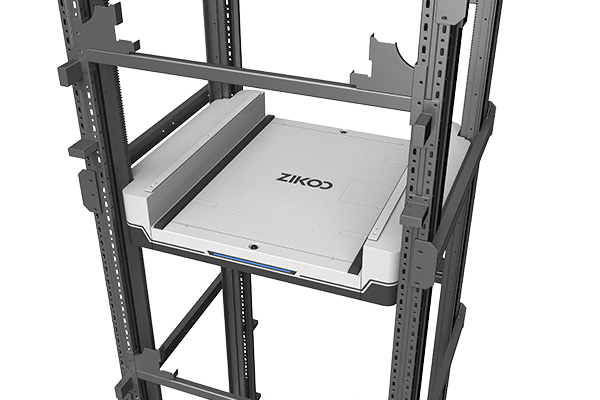
It also needs recovery modes for power loss, a blocked lane, or a lost pallet, so the system stops safely instead of instructing another shuttle into the same position. These exception paths are part of the system design, not a later software patch.
Pallet throughput is only as consistent as the software that sequences each mission and resolves exceptions. <Software-Driven Hardware: Six-Way Shuttle Maximizes Warehouse Efficiency> covers how WCS-level decision logic turns shuttle hardware into a stable warehouse system.
During supplier evaluation, the buyer should ask which system owns each command: who releases a pallet to the lane, who grants permission for the lift, and what happens when an operator pulls an emergency stop. The answers reveal whether the supplier is providing a coordinated storage system or a collection of vehicles that must be forced together on site.
Planning Your Deep-Lane Pallet Shuttle Storage Project
Before investing in shuttle racking, define the lane depth, pallet type, load weight, operating temperature, required pallet moves per hour, and WMS interface. Send those details, plus a layout drawing or building dimensions, to info@zikoo-int.com or call (+86)-19941778955.
The most useful inquiry also states the number of SKUs per lane, inbound and outbound peaks, pallet condition, and whether FIFO is mandatory. Those inputs help size the shuttle fleet, vertical lift capacity, and control-system workload rather than treating a single pallet dimension as the whole specification.
Frequently Asked Questions
How deep can a pallet shuttle lane go?
Lane depth depends on shuttle traction, pallet weight, rail length, rack tolerance, and acceptable cycle time. A lane can commonly be deep, but the practical limit is throughput and safe retrieval rather than a fixed pallet count. The shuttle must reach the deepest pallet and return the same distance. Before accepting a lane depth, verify the supplier’s tested lane length for the actual pallet, load, and floor conditions.
Is pallet shuttle storage FIFO or LIFO?
A single-face shuttle lane usually behaves as LIFO because loading and retrieval happen at the same aisle face. FIFO can be achieved in some layouts through software logic, flow-oriented rack or two-face operation, but it must be confirmed for the specific SKU rotation. If lot expiry or first-in-first-out discipline is critical, make the retrieval sequence an acceptance criterion rather than assuming that the rack style alone provides FIFO.
Can the system handle damaged or nonstandard pallets?
Pallet shuttle racking is less tolerant of damaged pallets than selective rack. Broken bottom boards, protruding nails, missing blocks, and excessive deflection can cause load transfer failures or lane jams. A pallet quality gate should check fork entry opening, bottom board condition, width, and sag. If the existing pallet pool is inconsistent, budget for pallet repair or replacement before the system processes live inventory.
Does a deep-lane shuttle system require WMS and WCS?
It depends on the automation level. A semi-automatic shuttle can operate with manual dispatching, but a multi-level or multi-shuttle system needs at least a WCS and a shuttle controller to allocate missions and avoid collisions. WMS is not mandatory for simple racking, but it becomes important when inbound and outbound order flow must be sequenced across zones. The supplier should define which system owns each command and which exceptions remain manual.
If you’re interested, check out these related articles:
Six-Way Shuttle: The Smart Warehousing Tool for Cost Reduction and Efficiency 2
PTP Intelligent Warehouse Software Empowers Enterprises for Smart Upgrades
Six-Way Shuttle Empowers 3PL Providers to Build Next-Generation Smart Logistics Hubs
Revolutionizing Cold Chain Logistics: Zikoo Robotics Six-Way Shuttle Powers High-Density, High-Efficiency Warehousing
Looking for Reliable Four-Way Shuttle Manufacturers? Choose Zikoo Robotics